At a glance
- Duration:
- 8 Days
- Start/End:
- St. Louis, Missouri (Alton) to St Paul, Minnesota
- From:
- $5,499
- Time of Year:
- June - September

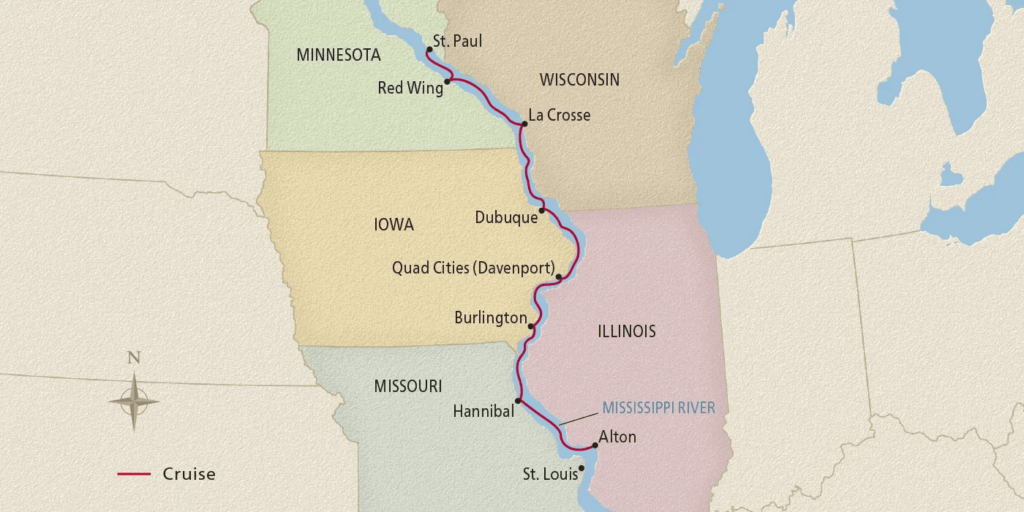
Embark on Heartland of America, an immersive 8-day journey along the legendary Upper Mississippi River where the soul of the American Midwest comes alive with history, culture, and scenic beauty.
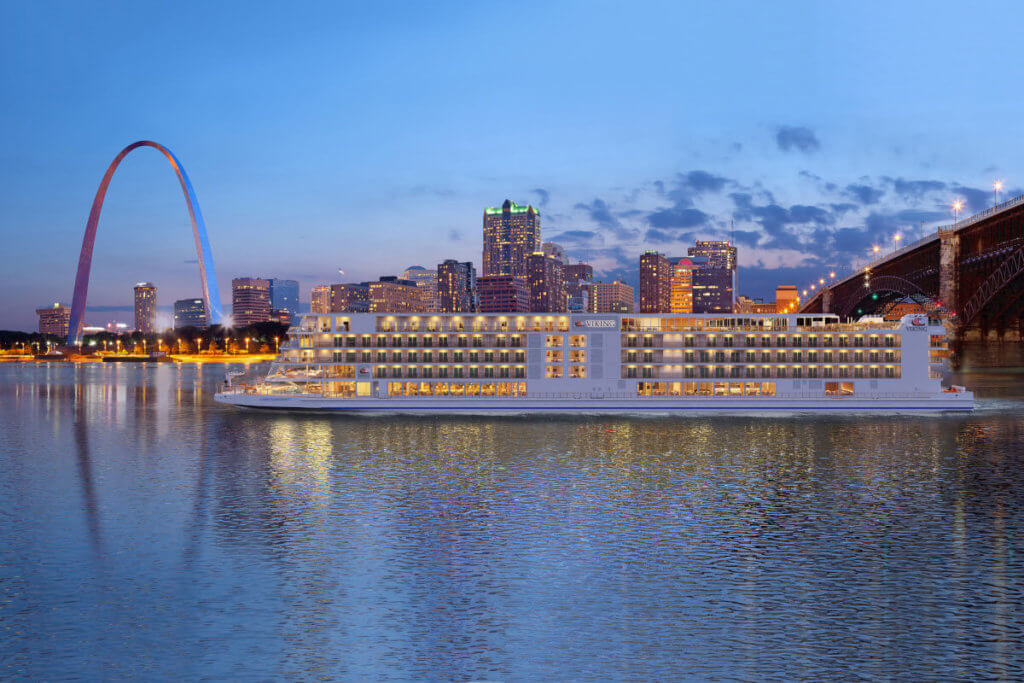
Beginning in St. Louis (Alton), Missouri, you’ll set sail amid the lush river landscapes at the Meeting of the Great Rivers and feel the quintessential allure of America’s heartland unfold before you. As your elegant Viking vessel glides north, each day brings a new chapter of discovery, from the quaint river-town charm of Hannibal, Missouri,the boyhood home of Mark Twain and the inspiration for his iconic tales, to Burlington, Iowa, where majestic historic theaters and churches echo stories of the past.
Navigate further into the agricultural expanses of the Quad Cities, truly the “breadbasket” of the nation, before arriving in Dubuque, Iowa, with its inviting Cathedral Historic District and period lampposts that light up tales of a bygone era. In La Crosse, Wisconsin, delve into the region’s Scandinavian roots and cheese-making traditions, and absorb the picturesque river views that have shaped life along these waters for centuries.
Each port of call offers thoughtfully curated experiences that blend local heritage with immersive storytelling, whether you’re tracing the legacy of early pioneers, learning about Norwegian immigration, or savoring hearty Midwestern fare. Your voyage continues through Red Wing, Minnesota, a place celebrated for its craftsmanship from stout shoes to distinctive pottery, before drawing to a close in the twin-city capital of St. Paul, Minnesota, where you’ll disembark with a deeper appreciation of the region’s vibrant tapestry and many hidden treasures.
Throughout the cruise, Viking’s Inclusive Value ensures a seamless experience with shore excursions in every port, expertly guided tours, enriching lectures, all onboard meals highlighting regional specialties, and the chance to watch the river’s scenery change from the comfort of your riverside stateroom. From Civil War history to literary landmarks, small-town charm to metropolitan goodbyes, this itinerary captures the layered stories and warm spirit of America’s Heartland.
Heartland of America Details
Day-to-Day Itinerary
Day 1: St. Louis (Alton), Missouri, United States
Embark your ship and settle into your stateroom. Alton is the gateway to St. Louis, which was a passageway into the Louisiana Territory during the 19th century. In 1904, St. Louis gained recognition as host of a world’s fair (officially called the Louisiana Purchase Exposition), whereby some accounts the ice-cream cone was introduced. Today, it is home to rich architectural treasures—among them, the Cathedral Basilica of St. Louis, with its 41-million-piece mosaic; the Renaissance Revival City Hall; the 19th-century Old Courthouse; and the Gateway Arch, standing along the Mississippi as a monument to westward expansion.
Day 2: Hannibal, Missouri, United States
Hannibal is the childhood home of Samuel Langhorne Clemens, or Mark Twain, and the inspiration for his beloved stories of Tom Sawyer and Huckleberry Finn. Prior to the 1803 Louisiana Purchase and arrival of European settlers, a variety of indigenous Native American tribes called the area home. Hannibal grew into the primary port for steamboats and flatboats traveling the Upper Mississippi. “The Unsinkable Molly Brown,” the early 20th-century socialite, philanthropist and survivor of the Titanic tragedy, was also born here.
Day 3: Burlington, Iowa, United States
The US flag was first raised over Iowa in Burlington—in 1805—by Lieutenant Zebulon Pike during his Mississippi explorations. Later, it became an outpost for the American Fur Company, a trading enterprise founded by John Jacob Astor. In 1834, it took its present name after the Vermont birthplace of its first settler, John Gray. During the steamboat era, it was a major port along the river. Today, the city is home to many magnificent buildings on the National Register of Historic Places, including the art deco Capitol Theater and the Gothic Revival St. Paul’s Church.
Day 4: Quad Cities, Iowa, United States
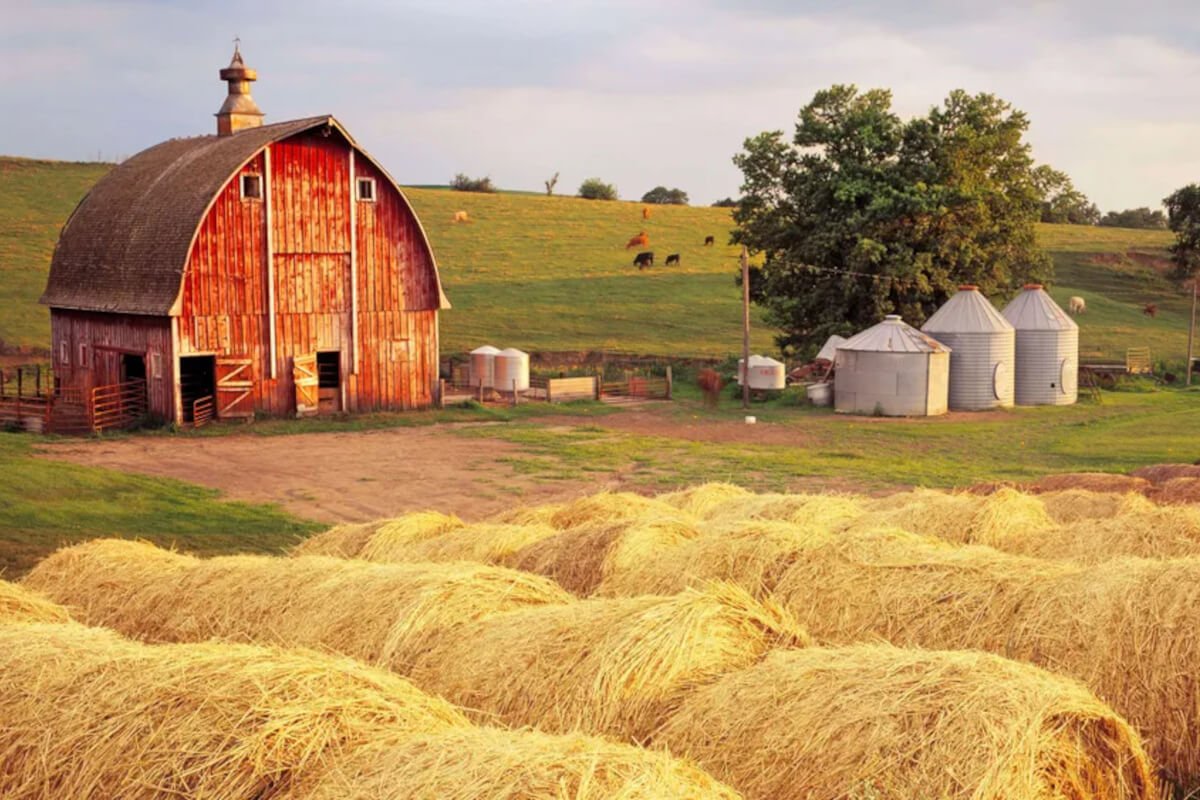
Straddling the confluence of the Mississippi and Rock Rivers, the Quad Cities area comprises Davenport and Bettendorf, Iowa, and Rock Island, Moline and East Moline, Illinois. As the only section of the Mississippi that flows from east to west, it is geographically unique. Its tightly knit riverside towns thrived due to thoughtful planning and effective leadership. Today, the Quad Cities rest amid the fertile farmland known as “America’s Breadbasket”—the nation’s most expansive and scenic agricultural region—and is home to agribusiness giants including John Deere.
Day 5: Dubuque, Iowa, United States
One of Iowa’s few cities laid out among rolling bluffs, Dubuque is called the “Masterpiece on the Mississippi” for its 19th-century ingenuity and modern-day cultural evolution. Timber and boatbuilding were central to the city’s growth, with wood harvested in Minnesota and Wisconsin. The spirit of this river town lives on in the Cathedral Historic District, dotted with well-preserved buildings and authentic period lampposts. Today, the city is praised for its livability and for its riverside developments, including a museum and aquarium dedicated to the Mississippi River.
Day 6: La Crosse, Wisconsin, United States
La Crosse has a deep connection to the towering bluffs and rolling farmland of the Norskedalen, or “Norwegian Valley.” Here, a Norwegian immigrant population has created a unique culture over generations. Historic immigrant villages dot the valley still, a collection of preserved homesteads reflecting a frontier way of life. Today, La Crosse boasts numerous sites on the National Register of Historic Places. Its important architectural landmarks, along with an array of engaging statues along the riverfront, make La Crosse feel like a vast open air museum.
Day 7: Red Wing, Minnesota, United States
Red Wing is known for its Red Wing Shoes, which produced footwear for soldiers in both world wars. The city was named after a Sioux chief whose red-dyed swan wing indicated his rank. The first settlers—many from New England—arrived in the mid-1800s. German, Irish and Scandinavian immigrants followed, bringing skills in tanning, shoemaking, pottery and more. The city boasts a diversity of legacies including Red Wing Stoneware and Pottery, founded in 1877 as the nation’s first commercial potter. Today, Red Wing enjoys a place in the National Trust for Historic Preservation.
Day 8: St. Paul, Minnesota, United States
Bid farewell to your fellow guests and journey home. Or spend more time exploring, perhaps joining one of our extensions.