
A traveler’s guide for the discerning small ship cruiser exploring one of the Mississippi’s most historically resonant ports of call
Location
Southeast Missouri, Mile Marker 51
Best Seasons
September – October & April – May
River Cruises
American Cruise Lines & Viking
Shore Time
Typically 6–8 hours
Perched on the limestone bluffs of the western Mississippi bank, 115 miles south of St. Louis and set just above the river’s confluence with the Ohio, Cape Girardeau is one of the great hidden treasures of an American river cruise. While its more celebrated neighbors, New Orleans, Memphis, St. Louis, tend to dominate the conversation, Cape rewards the curious traveler with something rarer: a genuine sense of place. Here, the past isn’t curated for tourists; it simply endures, in the architecture of the downtown, the sweep of the floodwall murals, the tangle of bluff trails, and the quiet intensity of a river city that has witnessed more history than it is usually given credit for.
Founded
1733 as a French trading post; incorporated 1843
Historic Register
39 sites on the National Register of Historic Places
River Position
Mile 51 — once the largest river port between St. Louis and Memphis
Population
~40,000 city; ~135,000 metro area
A Brief History
Cape Girardeau’s story begins in 1733, when a French officer named Jean-Baptiste de Girardot established a trading post on the western bank of the Mississippi, a strategic outpost positioned to capitalize on the river’s extraordinary commerce. The settlement was a crossroads from its earliest days, where Native American traders, French voyageurs, Spanish colonial administrators (who took control in 1762), and eventually American settlers mingled along the riverfront. By the time the Louisiana Purchase transferred the territory to the United States in 1803, the Cape had already developed a distinctive multicultural character that set it apart from the more homogeneous settlements that followed the frontier westward.
It was in that same year, 1803, that Cape Girardeau received perhaps its most famous visitors: Meriwether Lewis and William Clark, who paused here during their westward Corps of Discovery expedition. The encounter between the great river expedition and a frontier trading town that already possessed a courthouse, a post office, and a small but thriving commercial district speaks to how well-established Cape Girardeau had become, even before the nineteenth century was underway.
The antebellum decades transformed the city into the busiest river port between St. Louis and Memphis. Steamboats laden with grain, livestock, lumber, and cotton crowded the landing. An economy built on river commerce created a prosperous merchant class, whose ambitions are still legible in the grand Italianate and Greek Revival buildings that anchor the downtown historic district. The Civil War arrived violently in 1863, when Confederate General John Marmaduke’s troops attacked the Union-held city. Four earthen forts, Fort A, B, C, and D, had been constructed to defend Cape Girardeau, and the battle that followed, though strategically inconclusive, left a permanent imprint on the city’s memory. Fort D survives today as a restored historic site.
The twentieth century brought bridges, highways, and a gradual shift away from river commerce, but Cape Girardeau never lost its essential identity as a river city. Today, it is the home of Southeast Missouri State University, a vibrant medical sector, and a growing arts community, while its historic downtown core remains remarkably intact, a direct architectural conversation with the city’s steamboat-era past.
Steamboats once carried cotton, soldiers, and stories through this region. Today’s modern vessels invite travelers to retrace those currents in comfort and style, each dockside arrival in Cape Girardeau feeling, somehow, like a homecoming.
Arriving by Small Ship
For the small ship cruise passenger, Cape Girardeau offers one of the most convenient and satisfying port experiences on the entire Mississippi itinerary. Ships dock directly at Riverfront Park, a beautifully maintained recreational complex in the heart of the city, giving passengers immediate, walkable access to the historic downtown, the floodwall murals, and the main commercial district. No tender service, no shuttle buses: you step off the gangway and you are already in the city.
Cape Girardeau is a featured port on several key Mississippi itineraries operated through Sunstone Tours & Cruises’ preferred carriers, principally American Cruise Lines. It appears as a stop on the Complete Mississippi River Experience, the Grand Heartland Cruise (which traverses the full length of the river from St. Paul to New Orleans), and various itineraries that connect the cultural heartland of the Upper and Lower Mississippi. Viking’s Mississippi ships also call here on their Nashville–Memphis–St. Louis routes. Shore time is typically six to eight hours, ample to explore the downtown on foot, take a guided excursion to Fort D, and still return to the ship for cocktail hour.
Cruise Tip
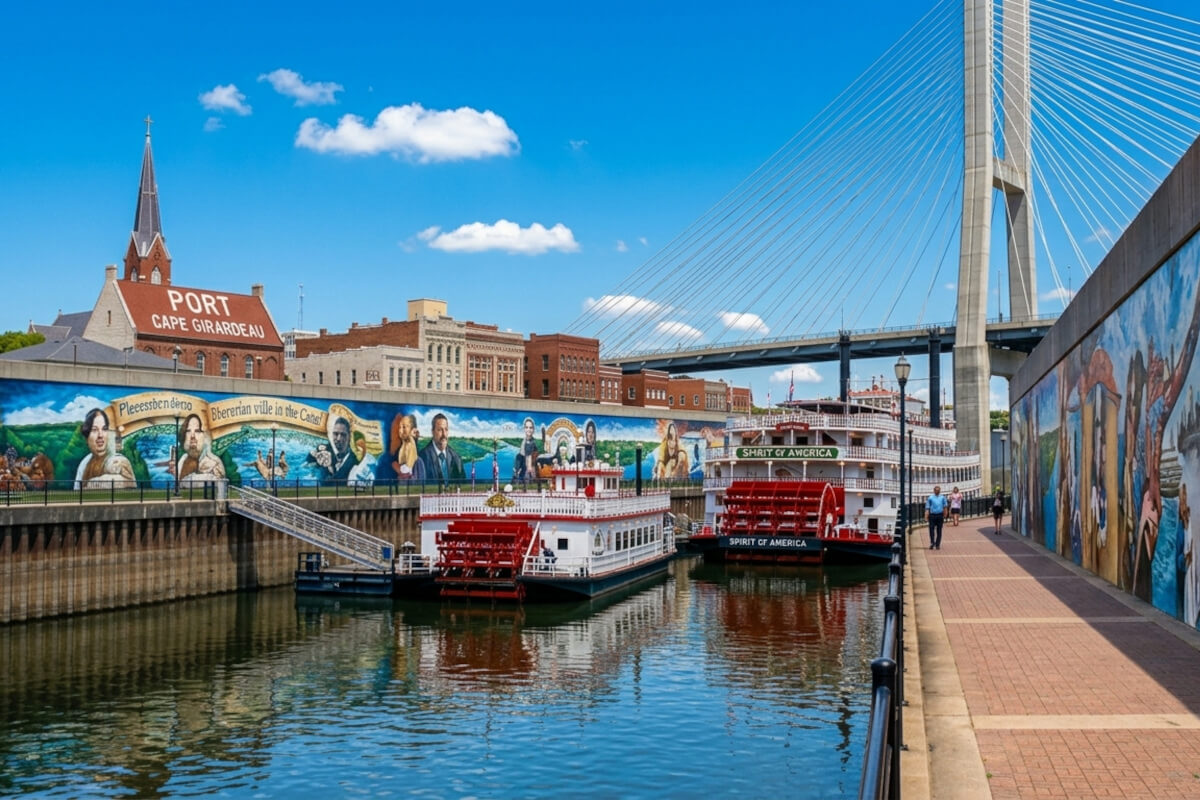
Ships dock at Riverfront Park, placing passengers within easy walking distance of all major downtown attractions. The Old Mississippi River Bridge Scenic Overlook, directly adjacent to the docking area, offers outstanding photography of the river and your vessel, especially in morning light. Plan this stop first before the day-trippers arrive.
Itineraries that visit Cape Girardeau, Missouri
| Itinerary | Duration | From (per person) |
|---|---|---|
Grand Heartland CruiseAmerican Cruise Lines · St. Paul to New Orleans | 16 days | From $11,030 |
Complete Mississippi River ExperienceAmerican Cruise Lines · New Orleans to Minneapolis | 23 days | Contact for rates |
Nashville, Memphis & the CumberlandViking Mississippi · Memphis to Nashville via Mississippi | 8 days | Contact for rates |
America’s Great RiverViking Mississippi · St. Paul to New Orleans | 15 days | Contact for rates |
Rates subject to change. Contact Sunstone Tours & Cruises at 1-888-815-5428 for current availability.
When to Visit
Cape Girardeau sits in the transition zone between the Midwest and the Upper South, which gives it a climate of genuine seasonal character, something that plays significantly in the cruise experience.
Prime Season
September – October
The consensus best time for Mississippi River cruising. Temperatures settle into the mid-60s to low-70s (°F), foliage begins its change along the bluffs, and river conditions are typically stable. Crowds are thinner than summer and the light is exceptional for photography of the floodwall murals.
Recommended
April – May
Spring brings flowering dogwood and redbud to the riverbanks and a vibrant energy to downtown. Be aware that spring flooding on the upper reaches of the Mississippi can occasionally require itinerary adjustments, a consideration cruise lines account for in their planning.
Acceptable
June – August
Summer cruises run regularly (June–October for American Cruise Lines), but heat and humidity can be significant. The river is fully alive with activity, and evening walks along the downtown are pleasant once the day cools.
Seasonal Highlight
December
Holiday cruises become available on select itineraries. Christmas markets in Cape Girardeau and St. Louis create a festive atmosphere, and the dramatic river scenery takes on a stark, painterly beauty in winter light.
Highlights: What to See & Do
The Mississippi River Tales Mural
No single attraction captures Cape Girardeau’s identity more vividly than its extraordinary floodwall mural. Spanning the entire length of the historic downtown, roughly 1,100 feet and 24 panels, the Mississippi River Tales Mural transforms the utilitarian concrete flood protection barrier into one of the most remarkable pieces of public art in the American interior. The panels chronicle the city’s story from its earliest Native American inhabitants through the French colonial period, the Lewis and Clark expedition, the Civil War, the steamboat era, and into the twentieth century. It is, in effect, an outdoor museum that every cruise passenger passes on the walk from the dock.
Insider Note
The mural is at its most photogenic in the early morning, when the light falls along the length of the floodwall. Allow at least 45 minutes to walk its full extent and read the interpretive panels, the detail rewards close attention.
Fort D Historic Site
One of four Union earthwork fortifications constructed to defend Cape Girardeau during the Civil War, Fort D is the sole survivor and is beautifully preserved as a city park with interpretive signage. The earthworks themselves are remarkably intact, a rare opportunity to walk the actual terrain where the 1863 Battle of Cape Girardeau was fought. For passengers whose itinerary includes Civil War history as a theme (as many Mississippi River cruises do), Fort D is a genuinely moving site that offers something the better-known battlefields cannot: solitude and contemplative quiet.
Cape River Heritage Museum
Housed in a historic building in the downtown core, the Cape River Heritage Museum offers the most comprehensive account of the city’s history available in a single location. Exhibits cover Native American pottery and early settlement, the French colonial period, the Civil War, and the steamboat age. For cruise passengers seeking historical depth beyond the walking tour, this is the essential stop, particularly strong on the river commerce and the industrial history that made Cape Girardeau one of the nineteenth century’s most significant Mississippi ports.
Trail of Tears State Park
A few miles north of the city, Trail of Tears State Park preserves one of the most sorrowful chapters in American history: the crossing of the Mississippi River by Cherokee people forcibly displaced from their Southeastern homelands in the winter of 1838–39. The park’s location at the river crossing site, where ice floes and bitter cold claimed hundreds of lives, is marked with interpretive trails, memorials, and a visitor center that contextualizes the Trail of Tears as a watershed moment in the nation’s moral history. For passengers on longer itineraries who want to engage with the full complexity of American river heritage, this site is essential and profoundly affecting.
The Broadway Street Historic District & Old Town Cape
The historic downtown district surrounding Broadway Street preserves an unusually complete stock of nineteenth and early twentieth century commercial architecture. Boutique galleries, antique shops of genuine quality, independent bookshops, and artisan studios occupy storefronts that retain their original facades. Old Town Cape, the broader designation for the walkable historic core, has developed a genuine creative economy, it is not a manufactured tourist district but a functioning neighborhood that happens to be exceptionally handsome. For the cruise passenger with a few hours and a credit card, the antique shops alone merit serious attention.
River Campus Cultural Arts Center
Southeast Missouri State University’s River Campus is an architectural jewel: a performing arts complex housed within and around a beautifully restored nineteenth-century building set directly on the Mississippi bluffs, with panoramic views of the river. The facility hosts professional-quality theater, music, and visual arts programming throughout the year. Cruise passengers arriving during a performance season may find evening tickets available; the venue’s location and views make even a pre-show visit worthwhile.
Dining: A Field Guide for the Discerning Traveler
Cape Girardeau punches well above its size in the quality of its dining options. With more than 140 restaurants ranging from casual regional spots to genuinely ambitious fine dining, the city offers cruise passengers a meaningful choice of shore-side culinary experiences. For those accustomed to the excellent onboard dining of a luxury American river cruise ship, the dining ashore in Cape Girardeau will hold its own.
| Restaurant | Style | What to Know |
|---|---|---|
Gabriel’s Food + WineDowntown Cape Girardeau | Fine Italian | Founded by a Milan-trained chef; extensive wine list with knowledgeable sommelier service. Signature mushroom and squash lasagna; duck fettuccine. Reservations strongly recommended. |
36 Restaurant & BarHistoric Downtown | Contemporary American | Contemporary American cuisine with locally sourced ingredients. Upscale steakhouse sensibility with creative seasonal preparations. A top choice for pre-embarkation or special occasion dining. |
Port Cape GirardeauRiverfront | Regional BBQ & Seafood | Cape’s storied barbecue institution: hickory-smoked pulled pork and ribs cooked up to 12 hours. River views from the private River City Yacht Club room upstairs. Live music on Sundays. The quintessential regional experience. |
Mary Jane Bourbon + SmokehouseDowntown | Craft Spirits & Smoked Meats | Named for the owner’s grandmother; chef-inspired smoked meats paired with hand-crafted bourbon cocktails. Locally sourced ingredients, live music, and a warm neighborhood atmosphere. |
CelebrationsCape Girardeau | Unique Fine Dining | A singular dining experience with individually themed rooms. Exceptional hospitality, genuine and unhurried. A favorite for special occasions among locals and visitors alike. |
Missouri Wine Country
Missouri is an emerging wine destination with a tradition of viticulture stretching back to German immigrant settlers of the nineteenth century. Several wineries in the Cape Girardeau region offer tastings, and themed wine cruises available through Sunstone Tours & Cruises incorporate Missouri winery excursions as a featured shore activity. The region’s Norton grape, a native American varietal with deep color and firm structure, is worth seeking out.
For the Affluent Cruise Traveler: Practical Intelligence
Shore Excursions
American Cruise Lines offers a “Cape Girardeau Local Loop,” a complimentary guided excursion for guests that covers the major downtown landmarks and the floodwall mural with expert narration. Beyond the complimentary offering, optional excursions to Trail of Tears State Park and Fort D are typically available at additional cost and are well worth the supplement. Passengers should book optional excursions early, capacity is limited on small ships and popular tours fill quickly.
Self-Guided Exploration
Cape Girardeau’s compact historic core is highly walkable from the Riverfront Park dock. A self-guided tour taking in the floodwall mural, the Old Bridge Overlook, the historic downtown, and the Cape River Heritage Museum can be accomplished comfortably in four to five hours, leaving time for a leisurely lunch ashore before return to the ship. The city’s visitors bureau (VisitCape.com) offers a detailed visitor guide and interactive map.
The Ships
Cape Girardeau is served by some of the finest vessels in American river cruising. American Cruise Lines’ modern riverboats, the American Serenade (175 passengers), American Melody (195 passengers), and American Heritage (150 passengers, an authentic paddlewheeler), all feature private balcony staterooms, glass-enclosed dining rooms with regional menus, sun decks, enrichment programming, and the intimate scale that distinguishes small-ship travel from the mass-market cruise experience. Grand Suites on these vessels start from approximately $9,985 per person on relevant itineraries, a price point that delivers genuine luxury and personal service in a deeply immersive setting.
What to Bring Ashore
Comfortable walking shoes are essential, the floodwall mural walk is level, but Fort D involves uneven earthwork terrain. Light layers in fall, sun protection in summer. The antique shops of Broadway Street reward the patient browser; bring a sense of adventure and a willingness to ship a purchase home. Serious collectors report exceptional finds, the city’s combination of deep historical roots, low tourist traffic, and a large university community creates an unusually rich antique market.
A Note on the River
One of the great pleasures of a small ship Mississippi cruise is the river itself as experienced from the deck between ports. The stretch approaching Cape Girardeau from the north passes through some of the river’s most dramatic limestone bluff country, with forested hills rising directly from the water’s edge and wildlife, great blue herons, bald eagles, white-tailed deer on the banks, in regular evidence. The ship’s expert naturalists typically provide narration on this segment, and the sun deck offers panoramic views that no photograph quite does justice to.
Beyond the Port: The Broader Context
Cape Girardeau sits at a fascinating inflection point on the Mississippi River, the boundary zone between what cruise operators call the Upper and Lower Mississippi experiences. To the north lies Mark Twain country: Hannibal, the limestone bluffs, the locks and dams of the Upper River, and a landscape of rolling Midwestern farmland that feels, at its best, like the America Twain actually wrote about. To the south lies Memphis, the Delta, the blues, Civil War Vicksburg, the antebellum grandeur of Natchez, and ultimately New Orleans, a completely different cultural register, warmer, more complex, more overtly Southern.
Cape Girardeau belongs to both worlds and neither. It has the Midwestern solidity of a river city that built its identity on commerce and industry, but its French colonial origins, its Civil War past, and its position on the cusp of the Upper South give it a layered historical character that rewards the curious traveler more than almost any other single stop on the river. It is also, and this matters on a river cruise, a city of genuine authenticity. The murals, the museums, the restaurants, the antique shops: none of it has been manufactured for the cruise passenger. It exists because the city has a living relationship with its own history, and travelers willing to engage with that history on its own terms will find themselves richly rewarded.