At a glance
- Duration:
- 15 Days
- Start/End:
- St Paul, Minnesota to New Orleans, Louisiana
- From:
- $11,999
- Time of Year:
- July, September

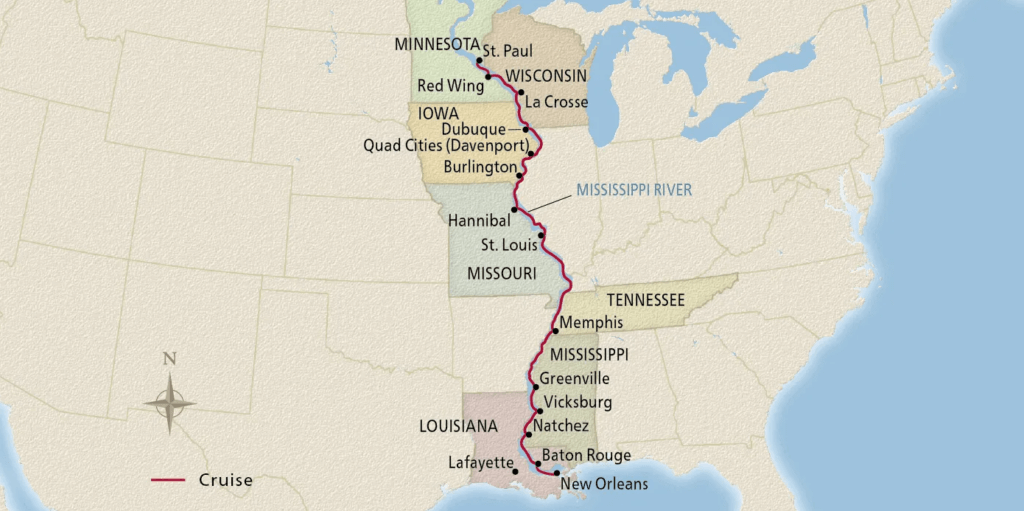
Embark on an unforgettable 15-day odyssey that traces the mighty Mississippi from its northern reaches in St. Paul, Minnesota to the vibrant, jazz-soaked streets of New Orleans, Louisiana. This river voyage is more than a cruise, it’s a cultural tapestry woven from American history, music, landscapes, and cuisine.
Your adventure begins amid the elegant late-19th and early-20th-century mansions that grace St. Paul’s historic districts, setting the tone for a journey steeped in local character and storytelling. As the ship glides southward, charming river towns like Red Wing, known for its heritage of craftsmanship, and La Crosse, with its Norwegian immigrant history and cheese traditions, offer intimate explorations of regional identity. In Dubuque and the Quad Cities, cobblestone streets and expansive agricultural vistas reveal the enduring spirit of America’s heartland, while Burlington’s historic architecture speaks to the river’s role in early commerce and community life.
The journey continues to Hannibal, Missouri, the boyhood home of Mark Twain and the inspiration for his timeless tales, before reaching St. Louis, where the iconic Gateway Arch frames stories of westward expansion. A day of scenic sailing ushers in the transition from the Upper to the Lower Mississippi, where lush wetlands and fertile farmlands unfold like a living painting. From here, the cultural pulse quickens: Memphis, Tennessee immerses you in the birthplace of the blues and deep civil rights history, while in Greenville, Mississippi, you’ll absorb the soul of the Delta with a Privileged Access experience that brings the region’s blues heritage to life.
Further south, Vicksburg’s pivotal Civil War battlefield offers a moving historical encounter, and Natchez’s antebellum estates evoke the grandeur and complexity of the Old South. In Baton Rouge, indulge in spirited Cajun and Creole flavors and vibrant local arts before the grand finale in New Orleans, where French Quarter jazz floats through the air and celebrations of life and culture await around every corner. Throughout this journey, the changing landscapes, from northern river bluffs to southern bayous — provide a dynamic backdrop, inviting you to savor regional cuisine, tap your feet to American folk, soul, and jazz rhythms, and deepen your understanding of the nation’s story from multiple angles.
From historic towns and metropolitan highlights to evocative music traditions and storied Civil War sites, America’s Great River delivers a compelling, immersive passage down the Mississippi that resonates long after the last whistle fades.
America’s Great River Details
Day-to-Day Itinerary
Day 1: St. Paul, Minnesota, United States
Embark your ship and settle into your stateroom. Located near the confluence of the Mississippi and Minnesota Rivers, St. Paul welcomed its first settler in 1838. And little more than a decade later, the thriving settlement was named the capital of the Minnesota Territory. By 1858, some 1,000 steamboats frequented this “Last City of the East” on the frontier. Today, St. Paul is a modern metropolis and the capital of Minnesota. The city’s historic residential districts invite long strolls, particularly around Irvine Park near the Mississippi, where late 19th- and early 20th-century mansions grace tree-lined streets.
Day 2: Red Wing, Minnesota, United States
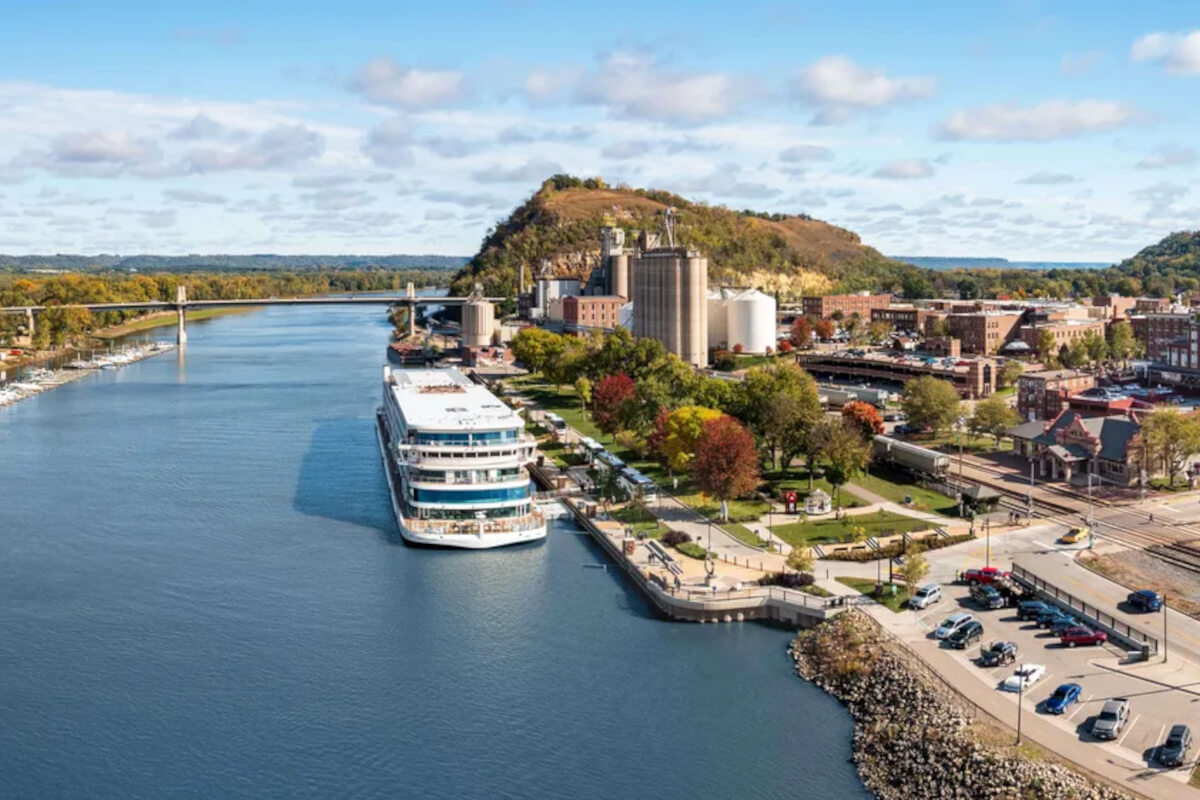
Red Wing is known for its Red Wing Shoes, which produced footwear for soldiers in both world wars. The city was named after a Sioux chief whose red-dyed swan wing indicated his rank. The first settlers—many from New England—arrived in the mid-1800s. German, Irish and Scandinavian immigrants followed, bringing skills in tanning, shoemaking, pottery and more. The city boasts a diversity of legacies including Red Wing Stoneware and Pottery, founded in 1877 as the nation’s first commercial potter. Today, Red Wing enjoys a place in the National Trust for Historic Preservation.
Day 3: La Crosse, Wisconsin, United States
La Crosse has a deep connection to the towering bluffs and rolling farmland of the Norskedalen, or “Norwegian Valley.” Here, a Norwegian immigrant population has created a unique culture over generations. Historic immigrant villages dot the valley still, a collection of preserved homesteads reflecting a frontier way of life. Today, La Crosse boasts numerous sites on the National Register of Historic Places. Its important architectural landmarks, along with an array of engaging statues along the riverfront, make La Crosse feel like a vast open air museum.
Day 4: Dubuque, Iowa, United States
One of Iowa’s few cities laid out among rolling bluffs, Dubuque is called the “Masterpiece on the Mississippi” for its 19th-century ingenuity and modern-day cultural evolution. Timber and boatbuilding were central to the city’s growth, with wood harvested in Minnesota and Wisconsin. The spirit of this river town lives on in the Cathedral Historic District, dotted with well-preserved buildings and authentic period lampposts. Today, the city is praised for its livability and for its riverside developments, including a museum and aquarium dedicated to the Mississippi River.
Day 5: Quad Cities, Iowa, United States
Straddling the confluence of the Mississippi and Rock Rivers, the Quad Cities area comprises Davenport and Bettendorf, Iowa, and Rock Island, Moline and East Moline, Illinois. As the only section of the Mississippi that flows from east to west, it is geographically unique. Its tightly knit riverside towns thrived due to thoughtful planning and effective leadership. Today, the Quad Cities rest amid the fertile farmland known as “America’s Breadbasket”—the nation’s most expansive and scenic agricultural region—and is home to agribusiness giants including John Deere.
Day 6: Burlington, Iowa, United States
The US flag was first raised over Iowa in Burlington—in 1805—by Lieutenant Zebulon Pike during his Mississippi explorations. Later, it became an outpost for the American Fur Company, a trading enterprise founded by John Jacob Astor. In 1834, it took its present name after the Vermont birthplace of its first settler, John Gray. During the steamboat era, it was a major port along the river. Today, the city is home to many magnificent buildings on the National Register of Historic Places, including the art deco Capitol Theater and the Gothic Revival St. Paul’s Church.
Day 7: Hannibal, Missouri, United States
Hannibal is the childhood home of Samuel Langhorne Clemens, or Mark Twain, and the inspiration for his beloved stories of Tom Sawyer and Huckleberry Finn. Prior to the 1803 Louisiana Purchase and arrival of European settlers, a variety of indigenous Native American tribes called the area home. Hannibal grew into the primary port for steamboats and flatboats traveling the Upper Mississippi. “The Unsinkable Molly Brown,” the early 20th-century socialite, philanthropist and survivor of the Titanic tragedy, was also born here.
Day 18: St. Louis, Missouri, United States
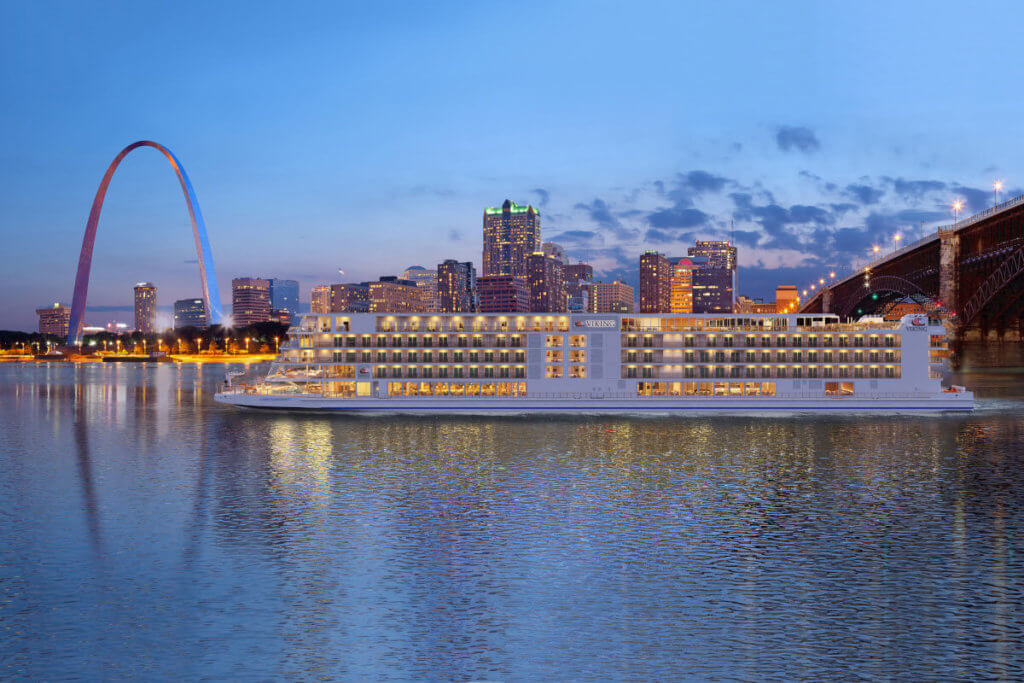
During the 19th century, St. Louis was a gateway into the Louisiana Territory. In 1904, the city gained recognition as host of a world’s fair (officially called the Louisiana Purchase Exposition), whereby some accounts the ice-cream cone was introduced. Today, it is home to rich architectural treasures—among them, the Cathedral Basilica of St. Louis, with its 41-million-piece mosaic; the Renaissance Revival City Hall; the 19th-century Old Courthouse; and the Gateway Arch, standing along the Mississippi as a monument to westward expansion.
Day 9: Scenic Sailing: Lower Mississippi
Teeming with a wide variety of birdlife and a breathtaking array of picturesque landscapes—including deep-green forests, lush wetlands and a patchwork of fertile farmlands—the Lower Mississippi abounds with natural beauty. This portion of America’s great waterway is also rich in history and culture, as reflected in the classic literature and music that have drawn inspiration from it.
Day 10: Memphis, Tennessee, United States
Situated on the Chickasaw bluffs overlooking the Mississippi River, Memphis is revered for its blues music and barbecue. Some of the most famed names in blues, including B.B. King, got their start in Memphis, and the city has a well-deserved reputation as the home of this classic American music genre. Memphis is also celebrated for its culinary heritage and is renowned for its traditional barbecue restaurants serving flavorful dry rub ribs. Rich in history and culture, Memphis’s many notable museums include the National Civil Rights Museum and Elvis Presley’s Graceland.
Day 11: Greenville, Mississippi, United States
Greenville is Mississippi’s largest river port, set atop the highest point along the Mississippi River between Vicksburg and Memphis. Its rural setting belies a diverse artistic heritage. The Muppets creator Jim Henson was born here, and the city has been home to numerous authors, including noted historian Shelby Foote. Greenville is also steeped in the blues; famed songwriter W.C. Handy was inspired to popularize the genre after seeing pioneering musician Prince McCoy perform at a nearby dancehall and neighboring Indianola was the hometown of the legendary B.B. King.
Day 12: Vicksburg, Mississippi, United States
Located on a high bluff where the Yazoo River flows into the Mississippi, Vicksburg is the epitome of Southern heritage and charm. It was incorporated in 1825 and, with its prime locale on the Mississippi, grew into an important port. During the Civil War, Abraham Lincoln called it “the key to the South.” And it indeed proved to be the site of the conflict’s most pivotal battle, the Battle of Vicksburg, after which the Confederates surrendered to Ulysses S. Grant. The Vicksburg National Military Park preserves the battle site’s rolling green fields and grand monuments.
Day 13: Natchez, Mississippi, United States
Natchez has one of the highest concentrations of historic Southern estates in the country. More than 200 perfectly preserved homes line its avenues. It is the oldest city on the Mississippi, established in 1716 by French colonists and named for the Natchez tribe who once called it home. With its ideal locale, the city became a crossroads among Native American and European cultures. Famously, Natchez was the southern terminus of the Natchez Trace, the overland route to Nashville that allowed traders to bypass the strong upriver currents. Today, it evokes small-town America.
Day 14: Baton Rouge, Louisiana, United States
Baton Rouge paints a historic picture on the eastern bank of the Mississippi. Its early success was due to its flood-free location upon the first natural bluff north of The Delta. French explorer Pierre Le Moyne, Sieur d’Iberville, named the city after a red-hued pole that marked the area’s tribal hunting grounds. Its cultural diversity—from its Cajun and Creole music and cuisine to its art offerings—reflects the influences of those who settled and lived here throughout Baton Rouge’s history. The city boasts the tallest capitol building in the United States.
Day 15: New Orleans, Louisiana, United States
Bid farewell to your fellow guests and journey home. Or spend more time exploring, perhaps joining one of our extensions.