
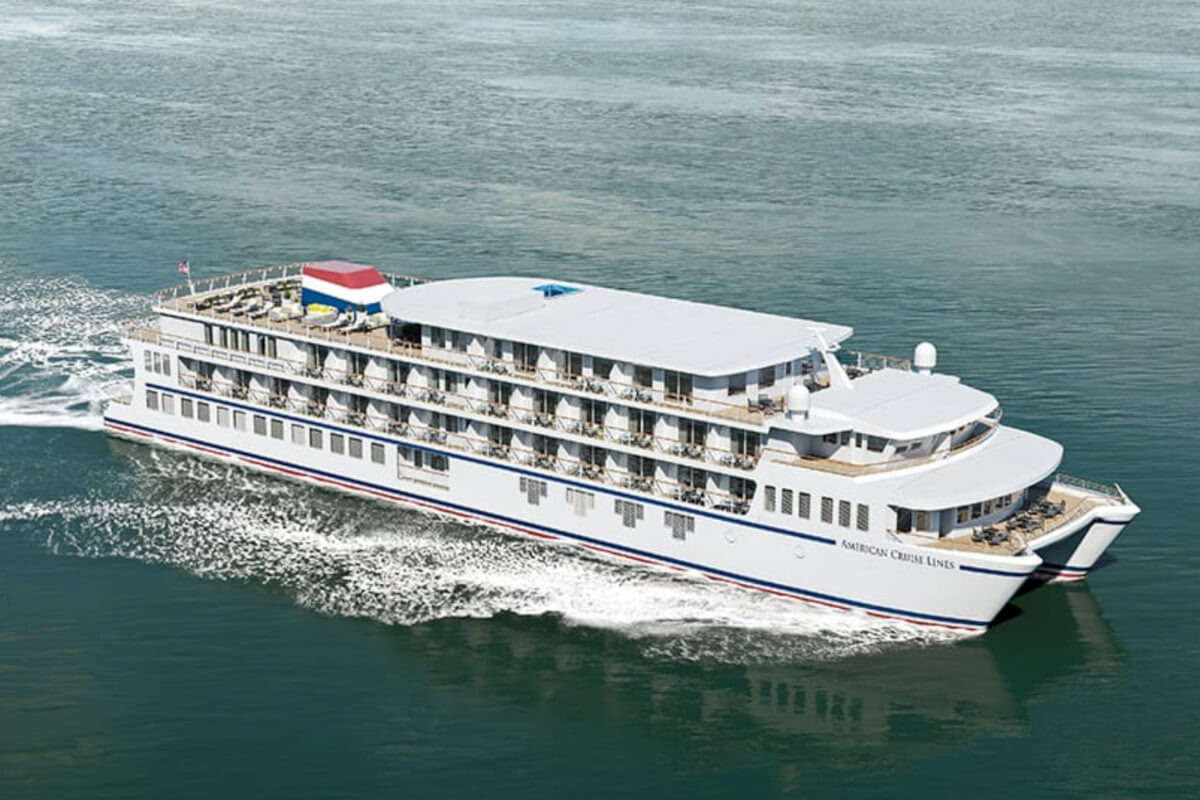
Before a new cruise ship ever welcomes its first guests aboard, it must complete an important final milestone known as sea trials, sometimes referred to as a “shakedown cruise.” This essential phase of shipbuilding is where months, and often years, of design, engineering, and construction are put to the ultimate test on the water.
Roughly a month before a vessel begins sailing with passengers, experts from the shipyard, along with operational teams from American Cruise Lines, board the newly built ship to conduct a comprehensive evaluation of its performance and seaworthiness. Because the line’s vessels are built at Chesapeake Shipbuilding in Maryland, these trials take place in the same waterways where the ships will ultimately operate.
Over a carefully planned period, typically lasting between 12 and 24 hours, the vessel is put through a detailed series of tests. Engineers, captains, and technical specialists assess how the ship performs under real operating conditions. Among the areas evaluated are:
- Speed and power, ensuring the vessel reaches and maintains its designed cruising capability
- Maneuverability, including tight turns, docking simulations, and handling in varying currents
- Propulsion systems, which power the ship through rivers and coastal waters
- Navigation and bridge technology, confirming that advanced navigation systems perform flawlessly
- Fuel flow and exhaust systems, which monitor efficiency and environmental performance
- Onboard equipment, verifying that mechanical systems operate smoothly
- Safety features, from alarms to emergency procedures
Although the term “sea trials” suggests open ocean testing, vessels in this fleet are primarily evaluated on the Intracoastal Waterway and the rivers they are designed to explore. This ensures the ship performs exactly as intended in the environments where guests will sail, from winding river passages to sheltered coastal routes.
Preparing the Crew for the First Voyage
Sea trials are not solely about testing machinery. They also provide an invaluable opportunity for the ship’s crew to train together in a real-world setting.
Bridge officers practice navigation procedures, engineers monitor systems under operational loads, and hotel staff begin refining onboard service routines. By the time the vessel is officially christened and begins welcoming passengers, every department has already worked together as a cohesive team.
During this period, inspectors from the United States Coast Guard also conduct thorough safety reviews. These inspections verify that the ship meets strict maritime safety regulations and is fully certified to carry guests.
A Tradition Rooted in Maritime History
Sea trials have been part of maritime tradition for centuries. In ancient seafaring cultures, testing a new vessel was simple, sailors would take the ship out and rely on their experience to judge how it handled the wind, waves, and currents.
As naval power expanded during the medieval and early modern eras, ship evaluations became more deliberate. Warships were tested for stability, maneuverability, and readiness for battle, although the process remained largely observational.
The Industrial Revolution transformed sea trials dramatically. With the introduction of steam engines, metal hulls, and increasingly complex machinery, systematic testing became essential. Engineers began conducting speed trials, endurance runs, and mechanical inspections, supported by emerging engineering principles and maritime classification standards.
Modern Precision Meets Maritime Tradition
Today’s sea trials combine centuries of maritime tradition with sophisticated technology. Engineers use advanced instruments and digital monitoring systems to gather precise data on everything from engine output to navigation performance.
Despite the modern tools and rigorous technical analysis, the purpose of sea trials remains unchanged: to ensure that every vessel is safe, reliable, and ready to deliver an exceptional experience on the water.
For cruise guests, this process happens quietly behind the scenes. Yet it plays a vital role in ensuring that when you step aboard a new ship, everything, from the engines beneath the hull to the navigation systems on the bridge, has already proven itself on the water.
It is the final confirmation that the ship is ready to begin its journey, and ready to welcome travelers who appreciate the comfort, elegance, and thoughtful craftsmanship that define a refined cruising experience.