
Where Darwin First Set Foot — A Small Ship Adventure Cruise Guide
Of all the Galápagos Islands, none carries more historical weight, or rewards the curious traveler quite so richly, as San Cristóbal. Easternmost of the archipelago, it was here that Charles Darwin first stepped ashore in September 1835, setting in motion a chain of observations that would eventually reshape humanity’s understanding of life on Earth. More than 180 years later, the island still draws explorers, naturalists, and adventure travelers seeking the same sense of wonder that greeted Darwin on that volcanic shore.
For the small ship cruise traveler, San Cristóbal is both a gateway and a destination in its own right. Serving as the administrative capital of the Galápagos Province and home to one of only two airports in the islands, it is often the first or last port of call on an expedition itinerary, yet it offers far more than a logistical waypoint. Pristine beaches, a freshwater highland lake, iconic geological formations, and an extraordinary concentration of endemic wildlife make San Cristóbal an essential and unforgettable chapter in any Galápagos voyage.
Geology & Geography
San Cristóbal is one of the oldest islands in the Galápagos archipelago, emerging from the sea approximately 2.4 million years ago. The island is composed of three or four large shield volcanoes fused together by successive lava flows over geological time. Because the Nazca tectonic plate has been carrying the island eastward, away from the volcanic hot spot that continues to build younger islands to the west (such as Fernandina and Isabela), San Cristóbal’s volcanoes are now extinct, and the landscape reflects millions of years of erosion and ecological succession.
The island spans roughly 215 square miles and reaches a maximum elevation of approximately 2,400 feet (730 meters). This height is significant: it creates a diversity of microclimates and vegetation zones rarely found on other islands, from arid coastal lava fields to mist-drenched highland forests. The lush western highlands are among the most fertile terrain in the Galápagos, while the drier eastern and northeastern shorelines retain the dramatic lava landscapes more typical of younger islands.
Puerto Baquerizo Moreno, the island’s principal town and the provincial capital of the Galápagos, sits on the southwestern tip. With a population of approximately 6,000 people, it is the second most populated settlement in the islands after Puerto Ayora on Santa Cruz.
History: From Pirates to Darwin
Discovery and Early Visitors
The Galápagos Islands were first sighted by Spanish bishop Tomás de Berlanga in 1535, after his vessel was blown off course while sailing from Panama to Peru. His accounts of extraordinary wildlife, particularly the giant tortoises, began filtering into European maps and imagination. For centuries afterward, the islands served primarily as a stopover for pirates and buccaneers, who gave individual islands English names still recognizable today. San Cristóbal was known as “Chatham Island” in those early charts.
Whalers and naval vessels from Europe and North America frequented the islands throughout the 18th and early 19th centuries. The tortoises were viewed as an almost inexhaustible food source, they could survive for months aboard ships without food or water, and thousands were taken from the islands, severely depleting their populations. When HMS Beagle called at the Galápagos in 1835, the crew took some 50 tortoises from San Cristóbal alone.
Charles Darwin and the Beagle, 1835
On September 15, 1835, HMS Beagle entered Galápagos waters, and those aboard first sighted Mount Pitt, today called Punta Pitt, rising from the open ocean at the northeastern tip of San Cristóbal. Three days later, on September 18, Darwin and assistant surveyor John Stokes were authorized to go ashore at Stephen’s Bay (near present-day Cerro Brujo), making San Cristóbal the very first island Darwin set foot on in the Galápagos.
“The black rocks heated by the rays of the vertical sun like a stove, give to the air a close and sultry feeling…” — Charles Darwin, upon first landing at San Cristóbal, 1835
Darwin’s initial impressions were not entirely favorable, he described the inhospitable black lava, strange smells of desert plants in flower, and reptiles unlike anything he had encountered. Yet it was here that he collected his first critical specimen: the San Cristóbal mockingbird, a bird whose subtle differences from mockingbirds on other islands would later form a key thread in his developing theory of evolution by natural selection. Darwin visited San Cristóbal five times during the Beagle’s eight-day survey of its coast. Only four islands were physically explored by Darwin on the entire voyage: San Cristóbal, Floreana, Isabela, and Santiago. His masterpiece, On the Origin of Species, was published some 25 years later, though the seeds of that revolution were planted on these volcanic shores.
A statue of Darwin stands today along the waterfront in Puerto Baquerizo Moreno, commemorating that pivotal landing. The spot itself remains a pilgrimage for curious travelers, naturalists, and biologists from around the world.
Settlement and the Modern Era
San Cristóbal holds the distinction of having the oldest permanent human settlement in the Galápagos. The key reason was practical: the island possesses El Junco Lagoon, the only permanent natural freshwater lake in the entire archipelago. This reliable water source made long-term habitation possible in an otherwise challenging environment.
What began as a penal colony in the 1880s gradually evolved into a functioning highland community. The fertile volcanic soils were put to use growing sugarcane, coffee, and cassava, while the highlands supported cattle ranching. The original settlement, El Progreso, a small village roughly seven miles from the coast, endures today as a modest farming community, and its historic significance as the Galápagos’s earliest surviving settlement lends the island a layered, human dimension that complements its natural wonders.
Puerto Baquerizo Moreno developed along the coast over the 20th century and was eventually designated the official capital of the Galápagos Province of Ecuador. Today it functions as the administrative and legal center of the islands, with a relaxed coastal atmosphere, local restaurants, and a colorful malecón (waterfront promenade) frequented by sea lions and surfers alike.
Best Time to Visit
The Galápagos, and San Cristóbal specifically, can be visited year-round, and remarkable wildlife encounters await in every season. However, seasonal shifts meaningfully shape the experience, and understanding them helps travelers choose the timing that best aligns with their interests.
Warm Season: December through May
The warm season brings water temperatures between roughly 22°C and 26°C (72–79°F), calmer seas, and excellent underwater visibility, making this the preferred period for snorkeling and diving. Landscapes green up beautifully after seasonal rains. Early in the year, green sea turtles nest and hatch along the beaches, drawing wildlife enthusiasts from around the world. By March, frigatebirds on San Cristóbal begin their striking mating displays, puffing out their vivid red throat pouches to attract mates, one of the most memorable wildlife spectacles in the islands. Sea lions, land tortoises, and other species also begin their own breeding cycles during this period.
Cool/Dry Season: June through November
The cool, dry season is driven by the Humboldt Current, which brings colder, highly nutrient-rich waters northward from the deep Pacific. Sea temperatures drop, the ocean becomes choppier, and frequent misty garúa (highland drizzle) settles over the upper elevations. While seas can be rougher and more challenging for first-time sailors, the increased nutrients in the water drive extraordinary marine productivity, feeding frenzies, active seabird colonies, and heightened underwater life. Galápagos penguins and flightless cormorants become particularly active during these months. The cool season also tends to have slightly lower visitor volumes, which some travelers prefer for a more private experience.
Quick Reference: Seasonal Wildlife Highlights
- January–February: Green sea turtle nesting and hatching; calm, clear waters for snorkeling
- March–April: Frigatebird mating season; sea lions pupping; highland vegetation at its lushest
- May–June: Transition season; waved albatross arrive on Española; good conditions across the board
- July–September: Cool Humboldt Current peaks; active marine life; penguin and cormorant activity
- October–November: Whale shark sightings possible; humpback whales; ongoing seabird activity
- December: Holiday voyages; warming waters; increasing snorkeling visibility
Highlights: What to See and Do
Kicker Rock (León Dormido)
Rising dramatically from the open Pacific roughly two hours’ sailing off San Cristóbal’s western coast, Kicker Rock, known in Spanish as León Dormido, or “Sleeping Lion”, is arguably the single most iconic natural landmark associated with San Cristóbal. Two towering volcanic tuff formations soar hundreds of meters above the ocean surface, split by a narrow channel of water through which small expedition vessels and Zodiacs can pass. The surrounding waters are among the best dive and snorkel sites in the entire Galápagos, with regular sightings of Galápagos hammerhead sharks, Galápagos sharks, rays, sea lions, sea turtles, king angelfish, and a brilliant array of reef fish. Circumnavigating Kicker Rock by Zodiac is a highlight of virtually every San Cristóbal small ship itinerary.
Punta Pitt
Located at the far northeastern tip of San Cristóbal, Punta Pitt is the spot first sighted by Darwin from the Beagle in 1835, Mount Pitt breaking the horizon from 50 miles at sea. Today it remains one of the most rewarding visitor sites in the Galápagos. A wet landing deposits passengers on an olivine beach before a trail climbs through volcanic tuff to a series of dramatic viewpoints. Punta Pitt holds the rare distinction of being one of the only sites in the Galápagos, and indeed the world, where all three species of booby (blue-footed, red-footed, and Nazca) can be observed together in a single visit. Two species of frigatebird also nest here, alongside a bachelor sea lion colony. The snorkeling offshore is excellent.
Cerro Brujo (Wizard Hill)
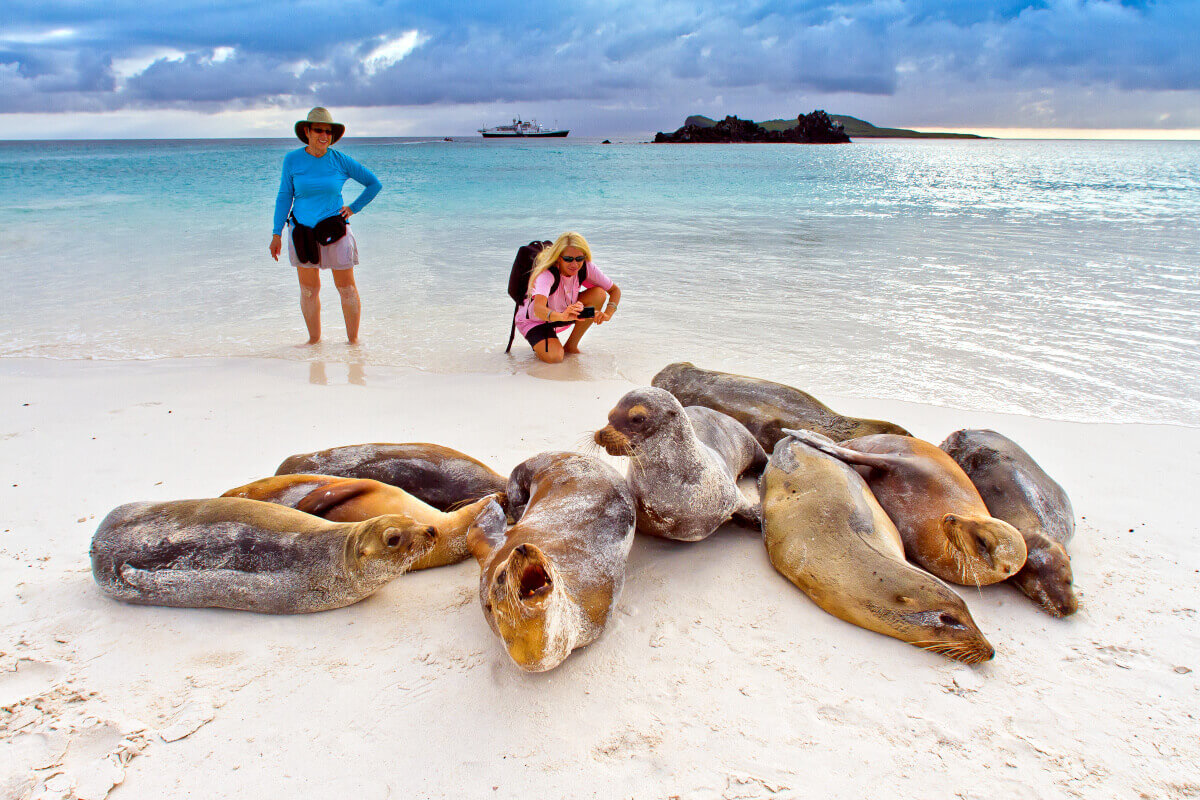
Cerro Brujo is an eroded volcanic hill on San Cristóbal’s northwestern coast, framing one of the most strikingly beautiful beaches in the Galápagos, a wide, almost powdery stretch of white coral sand lapped by crystalline water. Sea lions recline along the shore in characteristic indifference to visitors, while marine iguanas navigate the tide line and seabirds drift overhead. The dramatic rock formations known locally as “The Cathedral” punctuate the coastline, shaped over millennia by wind and sea. Darwin himself is believed to have landed near Cerro Brujo on his initial arrival at the Galápagos, lending the site an additional historical resonance. Kicker Rock can be seen rising from the ocean in the distance from this beach.
Cerro Tijeretas (Frigatebird Hill)
A short walk from Puerto Baquerizo Moreno leads to Cerro Tijeretas, where a well-maintained trail (including a boardwalk section accessible from the Interpretation Center) climbs to a panoramic lookout over the bay and surrounding coastline. The hill is named for the frigatebirds, tijeretas in Spanish, for their scissor-like tails, that nest in large colonies here. Both great and magnificent frigatebirds can be observed nesting side by side, a rare opportunity to compare the two species directly. The snorkeling in the cove below the hill is excellent, with sea lions typically present in the water year-round. The 45-minute round trip is suitable for most fitness levels and offers 360-degree views of sea and island.
El Junco Lagoon
At approximately 600 feet above sea level in the island’s green highlands, El Junco is the only permanent natural freshwater lake in the Galápagos, a flooded volcanic crater roughly 900 feet wide and 15 feet deep, fed by rainfall and garúa mist. The lake played a direct role in San Cristóbal’s history, its reliable fresh water enabled the Galápagos’s earliest human settlement. Today, El Junco is a sanctuary for highland birdlife: white-cheeked pintail ducks nest along its shores, seven species of Darwin’s finches inhabit the surrounding vegetation, and frigatebirds are frequently seen bathing here, washing salt from their feathers in the only freshwater available to them in the islands. Views on clear days extend across the entire island.
The Galápagos National Park Interpretation Center
Widely considered one of the finest natural and cultural history museums in Ecuador, the Interpretation Center in Puerto Baquerizo Moreno is a mandatory stop for cruise visitors, as required by the Galápagos National Park. Set just north of town along a pleasant boardwalk, the center explores the volcanic formation of the islands, the arrival and evolution of species, the climate and ocean currents that shape the ecosystem, and the full arc of human history in the Galápagos from first discovery through the present-day conservation era. A topographical scale model of the islands, covering both land and seabed, is among its most striking exhibits. The center also houses an outdoor stadium and meeting facilities used for ongoing research and education.
La Galapaguera de Cerro Colorado
Located roughly an hour from Puerto Baquerizo Moreno by road in the island’s northeastern highlands, the La Galapaguera tortoise breeding center allows visitors to observe San Cristóbal giant tortoises (Chelonoidis chathamensis) in various life stages, from freshly hatched young to the massive adults approaching a century in age. Hatchlings from their birth through approximately 120 days are raised in the center before being released into their natural highland habitat, a conservation program essential to sustaining the island’s endemic tortoise population. The native vegetation of the surrounding area, dense with endemic plants, provides additional ecological context for the visit.
Isla Lobos and Ochoa Beach
A short Zodiac ride from Puerto Baquerizo Moreno, Isla Lobos, “Sea Lion Island”, lives up to its name with a noisy, photogenic colony of Galápagos sea lions that greet arriving boats with characteristic curiosity. Blue-footed and Nazca boobies also nest on the island, and the snorkeling opportunities around its rocky islets are excellent. Nearby Ochoa Beach, a horseshoe-shaped cove on the island’s northeastern coast, offers calm waters ringed by white sand and volcanic outcroppings, with sea lions, herons, pelicans, blue-footed boobies, and Sally Lightfoot crabs regularly in attendance. The beach can be reached by kayak on certain itineraries, making it a particularly immersive way to arrive.
Puerto Baquerizo Moreno
The island’s capital town is an unusually relaxed and genuine community for a Galápagos visitor hub. The malecón (waterfront promenade) stretches along the harbor, where sea lions occupy benches, lounge at the base of lamp posts, and sprawl across any available surface with cheerful disregard for personal space. Local surf culture is thriving here, Tongo Reef to the west offers consistent breaks that attract riders from across Ecuador, adding an unexpectedly spirited dimension to an already dynamic port town. The Cathedral of San Cristóbal contains painted murals depicting Galápagos themes, and the Natural History Museum offers additional context for the island’s biodiversity.
Wildlife of San Cristóbal
The Galápagos archipelago is celebrated worldwide for the fearlessness of its wildlife, animals that evolved without land predators and show virtually no instinctive response to human presence. San Cristóbal exemplifies this quality while also offering a number of species found nowhere else on Earth.
Endemic Species
- San Cristóbal Mockingbird (Mimus melanotis): One of four Galápagos mockingbird species, found only on San Cristóbal. This was the very bird Darwin collected on his first landing, whose variation between islands became a key early clue to the mechanism of natural selection.
- San Cristóbal Lava Lizard (Microlophus bivittatus): An endemic reptile found only on this island, frequently encountered on coastal trails and rocky outcroppings.
- San Cristóbal Giant Tortoise (Chelonoidis chathamensis): The island’s endemic tortoise subspecies, observable in the wild in the highland forests and at the La Galapaguera breeding center.
Marine Mammals
- Galápagos Sea Lion (Zalophus wollebaeki): Ubiquitous on San Cristóbal beaches, docks, and even park benches. Frequently encountered while snorkeling, where they are playful and engaging in the water.
- Galápagos Fur Seal (Arctocephalus galapagoensis): More retiring than sea lions; found on rocky coastlines with shade and caves.
- Dolphins: Bottlenose and common dolphins are regularly sighted in offshore waters, sometimes bow-riding expedition vessels.
- Whales: Humpback and sperm whales may be sighted in season, particularly in the cooler months of the dry season.
Marine Life
- Galápagos Shark and Whitetip Reef Shark: Both species regularly seen at Kicker Rock and deeper snorkel sites.
- Hammerhead Shark: Kicker Rock is one of the best places in the Galápagos to encounter scalloped hammerheads, particularly on dives.
- Sea Turtle (Pacific Green Turtle): Present year-round; nest on beaches between January and April.
- Manta and Eagle Rays: Regular underwater sightings at Kicker Rock and Punta Pitt.
- Marine Iguana: The world’s only ocean-going lizard, present on virtually all rocky shorelines on San Cristóbal.
- Pacific Seahorse, King Angelfish, Moorish Idol, Parrotfish, Surgeonfish: Representative species of the vibrant reef community.
Birds
- Blue-Footed Booby: One of the Galápagos’s most charismatic species, frequently seen performing their distinctive high-stepping mating dance.
- Red-Footed Booby: The only booby that nests primarily in trees rather than on the ground; best observed at Punta Pitt and Isla Lobos.
- Nazca Booby: The largest of the three booby species; nests on the island’s headlands.
- Great and Magnificent Frigatebird: Both species nest at Cerro Tijeretas; males inflate brilliant red throat pouches during mating season (March onward).
- Waved Albatross: Seasonally present in Galápagos waters (primarily April–December); more commonly encountered near Española but possible offshore.
- Swallow-Tailed Gull: The world’s only fully nocturnal gull; nesting on cliffsides and sea stacks around the island.
- Brown Pelican: A constant and entertaining presence in Puerto Baquerizo Moreno harbor.
- Darwin’s Finches: Fourteen species found across the Galápagos; several represented on San Cristóbal, particularly around El Junco Lagoon.
- Galápagos Hawk: The apex predator of the archipelago; occasionally observed on highland trails.
Experiencing San Cristóbal by Small Ship Cruise
A small ship expedition cruise is widely recognized as the ideal way to experience the Galápagos, and San Cristóbal in particular. Larger vessels are prohibited from many of the most sensitive visitor sites, and strict Galápagos National Park regulations limit daily visitor numbers at each location. Small ships, by contrast, are able to anchor close to shore, deploy Zodiacs and kayaks directly into pristine coves, and operate with the flexibility to seize an unexpected wildlife encounter or adapt to sea conditions in real time.
Aboard vessels such as the National Geographic Islander II (48 guests) or the intimate National Geographic Delfina (16 guests), expedition teams led by expert naturalists, many holding advanced degrees in biology, ecology, or marine science, guide passengers through each site with in-depth commentary and genuine passion for the islands. Multiple excursion options each day allow travelers to tailor their activity level, whether they prefer a challenging highland hike, a drift snorkel through Kicker Rock’s channel, or a quiet Zodiac cruise along the coast.
San Cristóbal typically appears in the eastern and south-eastern itinerary variations, often paired with visits to Española, Floreana, and Genovesa. The Ultimate Galápagos Holiday Voyage by Lindblad Expeditions, for example, sails east to both Española and San Cristóbal and north across the Equator to Genovesa, delivering ten days of exploration across the archipelago aboard the 48-guest National Geographic Islander II, and representing one of the most comprehensive Galápagos experiences currently available.
What’s Typically Included on a Small Ship Expedition
- All meals and non-alcoholic beverages aboard ship
- Zodiac cruises, kayaking, stand-up paddleboarding, and snorkeling with full gear (wetsuits, masks, fins)
- Daily guided excursions with expert naturalists
- Park and site entrance fees, special access permits, and port taxes
- Hotel accommodations on embarkation/disembarkation days
- Transfers to and from group flights
- Complimentary WiFi aboard select vessels
- Presentations and evening lectures in the ship’s lounge
Practical Traveler Notes
- Getting There: San Cristóbal has one of the Galápagos’s two airports (the other is on Baltra, near Santa Cruz). Direct flights operate from Quito and Guayaquil on the Ecuadorian mainland. Flights are the exclusive means of reaching the islands for international travelers.
- Entry Requirements: All visitors pay a Galápagos National Park entrance fee upon arrival (currently $200 USD for international visitors; fees are subject to change). A valid passport is required. There is no visa required for most nationalities for a stay of up to 90 days in Ecuador.
- What to Pack: Lightweight, moisture-wicking clothing in neutral tones; reef-safe sunscreen (required by park regulations); a reusable water bottle; sun hat; polarized sunglasses; and good water shoes or sandals for wet landings. Snorkeling gear is provided by expedition operators.
- Health and Safety: Altitude is not a concern on San Cristóbal itself, but some travelers overnight in Quito (elevation 9,350 feet) before or after their expedition — allow a day of acclimatization if sensitive to altitude. Sea conditions can be rough during the dry season; motion sickness medication is advisable for those susceptible.
- Photography: San Cristóbal’s wildlife is remarkably approachable. A camera with a moderate zoom lens is sufficient for most wildlife photography; wide-angle capability is valuable for underwater work. Waterproof housing or a dedicated underwater camera is recommended for snorkeling.
- Conservation: Park regulations prohibit touching or feeding wildlife, removing any natural materials from the islands, straying off marked trails, or bringing outside food items ashore. Visitors must be accompanied by a licensed naturalist guide at all visitor sites.
Why San Cristóbal Belongs on Every Galápagos Itinerary
San Cristóbal is simultaneously the Galápagos’s most historically significant island and one of its most ecologically diverse. It is where the story of modern evolutionary science began, where a 26-year-old naturalist named Darwin stepped ashore on volcanic rock, collected a mockingbird, and eventually changed everything. And it is a place where, nearly two centuries later, travelers still arrive by small ship to find wildlife that greets them without fear, landscapes shaped by geological forces stretching back millions of years, and a living laboratory of adaptation unlike anything else on the planet.
Whether you arrive at Kicker Rock at dawn to watch hammerheads patrol the channel below the surface, hike to the rim of El Junco Lagoon as frigatebirds wheel overhead, or simply walk the waterfront in Puerto Baquerizo Moreno as sea lions nap around your feet, San Cristóbal delivers an intimacy with the natural world that is rare, precious, and increasingly understood as a gift worth protecting.
“This journey exceeded my expectations on many levels. Being an educator, I appreciated the expertise and articulation of what we were observing each day.” — Beverly D., Long Valley, NJ
A small ship expedition cruise remains the finest way to experience it, unhurried, expert-guided, and calibrated to the rhythms of the islands themselves. San Cristóbal is not simply a stop on an itinerary. For those who arrive open to its history and alive to its wildlife, it is where the Galápagos story begins.