
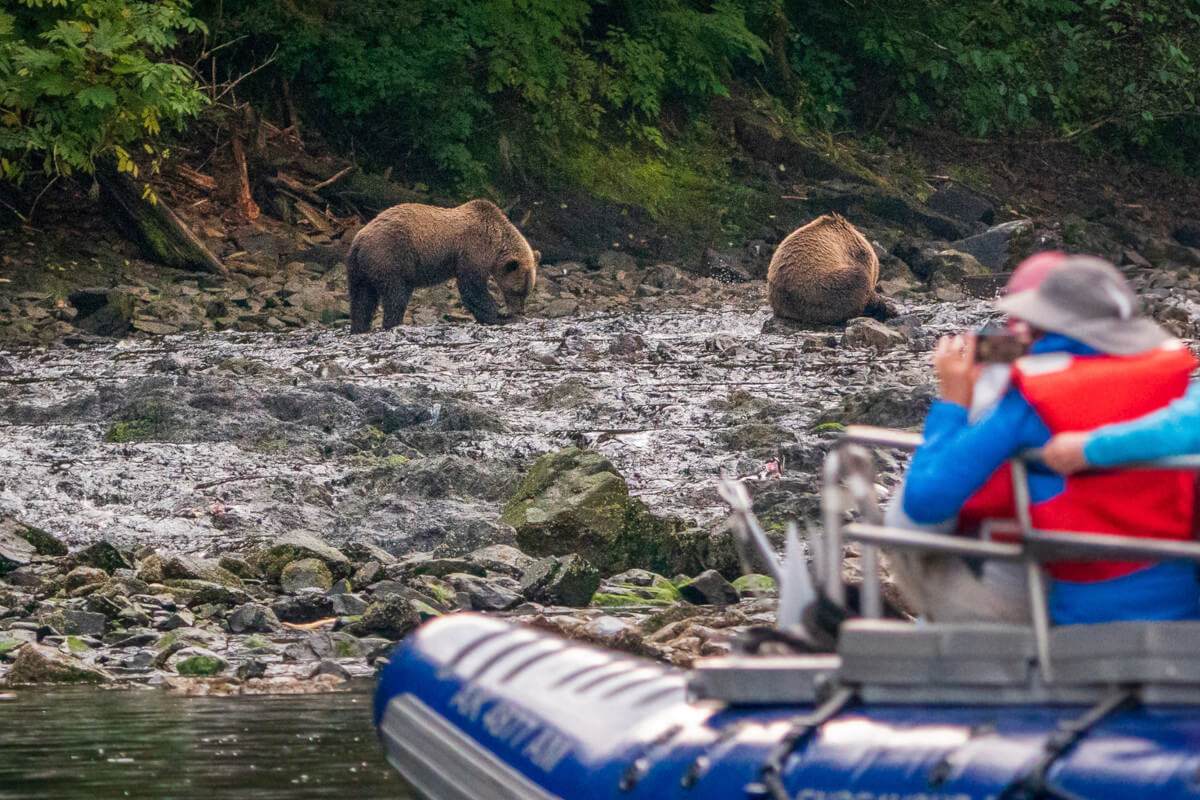
While the crowds chase Alaska’s peak-summer headlines, seasoned adventure cruisers are quietly booking the season’s final act, and coming home with the best stories.
Ask a first-time Alaska cruiser when to go, and they’ll say July. Ask someone who’s been three times. Chances are, they’ll tell you to wait.
Late August and September in Southeast Alaska represent one of the most rewarding, and most underappreciated, windows in all of adventure travel. The mega-ships are thinning out. The forests are beginning to glow. And the wildlife? It’s reaching the kind of frenzied, fattening-up-for-winter intensity that makes every skiff ride feel like a scene from a nature documentary.
For adventure cruise travelers, the kind who prefer kayaks to casinos and bear sightings to buffets, this is the sweet spot.
The wildlife show doesn’t stop; it transforms
Peak season (June through mid-August) earns its reputation for good reason: humpback whales are actively feeding in the Inside Passage, bears are visible along rivers, and the long daylight hours give you maximum time ashore. But the late season offers its own remarkable cast of characters, and some compelling advantages.
As salmon runs reach their crescendo in late August and September, brown and black bears shift into hyperphagia, a state of near-constant eating in preparation for hibernation. That means more bear activity along shorelines and rivers, and more predictable sightings for travelers patient enough to watch. Operators running small-ship expeditions, like UnCruise Adventures, take full advantage: their vessels can idle quietly in shallow coves that larger ships can’t access, letting guests observe bears from respectful distances without disturbing them.
- Brown & Black Bears Peak activity in late Aug–Sept as they gorge before hibernation. More predictable shoreline sightings.
- Humpback Whales Still present and feeding through September, some pausing near Sitka before heading south.
- Orcas Resident year-round, following abundant salmon. Strong sighting odds throughout the late season.
- Bald Eagles Congregate near salmon-rich rivers in fall, often in spectacular numbers along the Chilkat.
Humpback whales don’t disappear come fall, either. They linger in Southeast Alaska’s feeding grounds well into September, and some pause in the waters near Sitka to build reserves before their long migration south. Orca pods, matrilineal, highly social, and year-round residents of Alaskan waters, continue following salmon wherever the runs take them.
“Late summer and early fall bring other iconic animal encounters. Bears gorge on berries and salmon, stocking up before winter — and chuck fish leftovers into the forest, feeding the dramatic rainforest ecosystem around them.”
Color, light, and a quieter Alaska
By late August, Alaska’s tundra and coastal forests begin their annual transformation. Fireweed turns crimson. Cottonwoods go gold. The understory of the Tongass, the largest national forest in the country, shifts from its summer green into something richer and more atmospheric. For photographers and anyone attuned to landscape, it’s genuinely stunning.
The light changes too. Gone are the near-midnight sun conditions of June; in their place, golden-hour light that lingers longer and casts the fjords in amber and rose. Moody, mist-wreathed mornings give way to crystalline afternoons. This is the Alaska that ends up framed on walls.
And as the season winds toward its close, the crowds thin dramatically. Ports that hum with tour-bus energy in July feel more like themselves, quieter, more local, more authentic. For adventure travelers who came to connect with the wilderness, not navigate it through a crowd, this matters.
Northern lights: the bonus nobody plans for
Here’s what separates late-season Alaska from every other shoulder period in adventure travel: the aurora. As nights grow longer in September and darkness returns to latitudes that barely saw it all summer, the conditions for the northern lights become favorable for the first time since spring. The aurora borealis doesn’t appear every night, and it’s never guaranteed — but for travelers whose sailings coincide with clear skies and geomagnetic activity, the sight of green and purple ribbons over a glacier-fed bay is something no peak-season cruise can offer.
The practical case: fewer people, better prices
Beyond the aesthetics, the late season makes straightforward logistical sense for adventure travelers. Flights into Juneau and Sitka, the typical embarkation points for small-ship Alaska itineraries, are easier to book and often cheaper. Cabin availability on expedition vessels opens up. And for operators like UnCruise Adventures, whose ships carry anywhere from 22 to 86 guests, the smaller late-season passenger loads create an even more intimate atmosphere aboard.
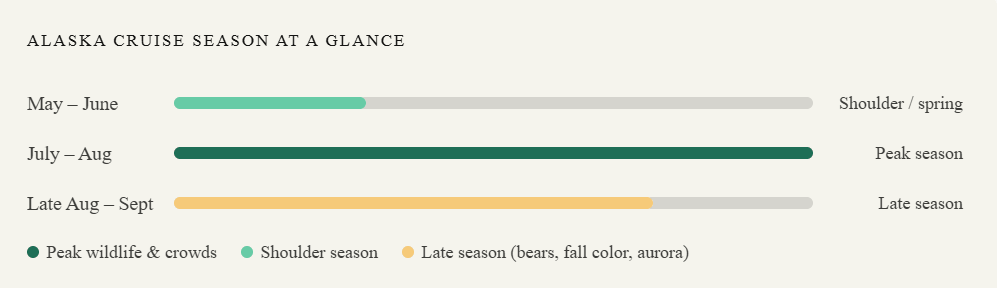
Late-season fares are typically more affordable, and the tradeoff, a slightly cooler, occasionally wetter day, is one that adventure travelers are generally well-equipped to handle. Pack waterproof layers, and the rain becomes part of the atmosphere rather than an inconvenience.
Why small ships make the late season sing
The late-season case is strongest for travelers on small expedition vessels. Large cruise ships, the ones carrying thousands of passengers, are constrained to major ports and predictable routes regardless of the season. But small-ship operators navigate differently. They can follow bear sightings into remote bays, linger at a glacier longer than the schedule demands, or detour into narrow fjords where the fall color is peaking.
UnCruise Adventures, which has pioneered small-ship adventure cruising in Alaska for nearly three decades, is an example of what this looks like in practice. Their vessels, some carrying as few as 22 guests, operate with flexible routing that responds to what naturalists and guides find each day. Kayaks and skiffs extend that reach further still, putting guests in a position to observe wildlife at a scale that no mega-ship excursion can replicate. The line also holds special permits for extended access to Glacier Bay National Park, a UNESCO World Heritage Site that limits visitation to less than one percent of travelers.
In late season, that flexibility becomes even more valuable. When a brown bear is working a salmon river and the schedule has nowhere urgent to be, a small ship can simply stay.
Who the late season is for
Not everyone. If your Alaska bucket list is anchored to glacier trekking in warm sunshine, the longest possible days, or traveling with school-age children, peak summer is still the right call. But if you’re drawn to Alaska for its wildness, to the bears and the whales and the feeling of genuine remoteness, the late season delivers that in abundance, with the added gifts of autumn color, possible aurora sightings, and a quieter passage through one of the planet’s last great wildernesses.
The savviest adventure cruisers figured this out a while ago. Their secret is getting harder to keep.
Plan Your Trip
Late season Alaska sailings book quickly
Small-ship expedition vessels have limited capacity and late-season departures often sell out well in advance. Look for itineraries in late August and September aboard lines like UnCruise Adventures, departing roundtrip from Juneau or one-way between Juneau and Sitka or Ketchikan. Contact Sunstone Tours & Cruises toll-free at 1-888-815-5428 for the latest availability for late season Alaska sailings.