
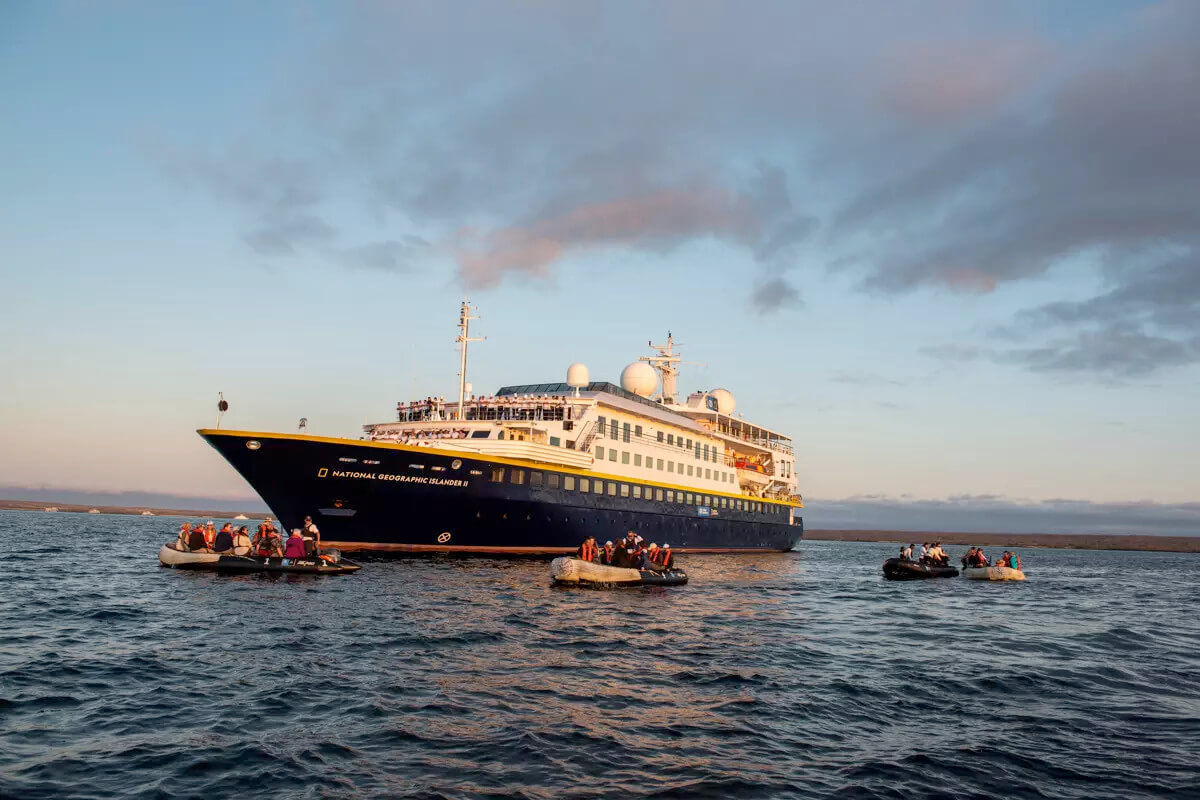
How Lindblad Expeditions is transforming the way adventure ships feed their guests, and why it matters most in the places you travel to protect.
You didn’t book a voyage to Antarctica, the Galápagos, or the fjords of Patagonia because you wanted the same experience you could get anywhere. You came because these places are among the last genuinely wild spaces on Earth, and because something in you understood that seeing them up close comes with a responsibility to leave them exactly as you found them.
That compact between traveler and destination is exactly what Lindblad Expeditions has been quietly rethinking in its ship’s galleys, and the results are extraordinary. A suite of new food-management and provisioning practices has cut onboard food preparation waste by as much as 75 percent, CEO Natalya Leahy announced. The number is remarkable not just as a business achievement but as a signal of how adventure cruise operators are finally aligning what they do at sea with the conservation values they ask their guests to hold on shore.
Why Food Waste Matters More on an Expedition Ship
On a mainstream cruise ship, food waste is a cost problem, and a significant one. But on an expedition vessel navigating the waters off South Georgia, threading through Arctic pack ice, or anchoring in a UNESCO-protected marine reserve, the stakes are categorically different.
Remote ecosystems are profoundly sensitive to introduced waste. The logistics of disposal are costly and complicated: waste generated in protected marine areas must be stored aboard until a port of call can receive it, and organic matter that enters wilderness water bodies can disrupt nutrient cycles that have taken millennia to establish. The smaller a ship’s crew and guest roster, and Lindblad’s vessels typically carry fewer than 150 guests, the more each individual’s footprint is amplified.
Put simply: the closer you get to the world’s most pristine environments, the more your dinner leftovers matter.
Reduction in food prep waste
Interlocking sustainability initiatives
Food waste to sea or port, goal
The Dinner Sign-Up: A Simple Idea with Outsized Impact
The headline initiative is deceptively straightforward. Each morning, guests aboard Lindblad vessels review the evening’s dinner options and indicate their preferences on a sign-up sheet. The galley team then knows, in advance, with reasonable precision, exactly how many portions of each dish to prepare.
For anyone who has cooked for a variable-sized group, the logic is immediately intuitive: you don’t roast five chickens if you know only two will be eaten. On an expedition ship sailing 800 miles from the nearest resupply point, that kind of precision isn’t just efficient, it’s essential. The program has delivered that 75-percent reduction in preparation waste, meaning that food being peeled, portioned, marinated, and cooked now almost exactly matches what ends up on plates.
As a guest, you may actually find this enhances the experience. The culinary team, freed from cooking at uncertain scale, can focus on quality and creativity. Meals aboard Lindblad ships, already a highlight for many guests, become even more intentional, with chefs preparing each dish with full knowledge that it will be appreciated and consumed.
There is also a quiet philosophical alignment at work. Expedition travel, at its best, is about intention: choosing where to go carefully, observing mindfully, treading lightly. Signing up for your dinner is a small ritual that connects you, however modestly, to the ship’s effort to operate with purpose in sensitive waters.
We have made significant strides through a combination of disciplined execution and innovative practices.
Provisioning From the Land You’re Sailing Past
The dinner sign-up solves the waste-during-preparation problem. But there’s a second, upstream challenge: what about the excess inventory that builds up when ships over-order supplies for a voyage?
Lindblad’s answer is local provisioning, sourcing food from markets, fishers, and farms close to each region of operation, rather than loading everything from a central provisioning hub at the start of a voyage. The approach reduces not only inventory waste but also the carbon cost of transporting food across hemispheres to meet a ship that will consume only a fraction of what it’s carrying.
For expedition travelers, there is a compelling experiential upside here too. Local provisioning means the fish on your plate may have been caught by a small-boat fisherman in the same channel you kayaked through that afternoon. The vegetables may have been grown on a farm that is, by expedition standards, practically next door. There is a directness to this that sits well with the ethos of traveling to understand places rather than simply passing through them.
It also connects Lindblad’s operations more tightly to the communities near the ecosystems it visits, communities that conservation-minded travel organizations have long argued should benefit economically from the presence of expedition ships in their waters.
Culinary Innovation
Zero Waste Galley Training
Lindblad’s culinary teams are now trained in zero-waste cooking techniques, a professional discipline that transforms every trim, peel, and bone into something useful rather than something discarded. In remote-environment operations, where resupply is measured in weeks rather than days, these skills are not optional. The training has particular emphasis on preservation methods suited to expedition conditions: fermentation, pickling, dehydrating, and whole-ingredient utilization.
New Technology Aboard
Food Dehydrators: Turning Scraps Into Resources
Perhaps the most tangible piece of new hardware in Lindblad’s sustainability push is the installation of food dehydrators aboard its vessels. Rather than accumulating organic waste that must be stored and offloaded in port, a logistical challenge in remote regions and an environmental risk if mishandled, the dehydrators convert food scraps into compact, dried by-products. These can be repurposed as ingredients in other dishes, stored for later use, or disposed of as a fraction of the original volume. It’s a practical, elegant solution to a problem that gets harder the farther from civilization a ship sails.
What This Means for the Adventure Traveler
If you’re the kind of traveler who reads the fine print on an operator’s environmental policy before booking, this is the kind of news that validates a choice. But even if sustainability is not your primary motivation for booking an expedition cruise, Lindblad’s initiative matters to you for a more immediate reason: the places you’re going are better protected when the ship that takes you there operates with genuine ecological discipline.
The Galápagos, which Lindblad has been serving since 1967 in partnership with National Geographic, are under constant pressure from overtourism, introduced species, and the logistical demands of sustaining human presence on fragile island ecosystems. Every kilogram of food waste that doesn’t need to be offloaded, every supply truck that doesn’t need to make an extra run, every invasive organism that never gets a foothold, these are the incremental victories that determine whether such places remain viable destinations for the next generation of travelers.
The same calculus applies in Antarctica, the Arctic, Baja California’s whale nurseries, and every other remote environment where Lindblad operates. These aren’t just backdrops for your adventure. They are living systems that tolerate human visitation only as long as that visitation is conducted with care.
The Broader Signal: Expedition Travel Growing Up
Lindblad’s food waste initiative is part of a broader maturation in expedition cruising. The sector has grown significantly over the past decade, with more operators, more ships, and a more demanding guest base, one that increasingly expects the companies taking them to wild places to be active stewards of those places, not merely visitors.
What makes the Lindblad approach notable is that it isn’t purely a sustainability gesture. CEO Leahy was explicit that these initiatives are also cutting costs, meaning the company has found the place where environmental responsibility and operational efficiency converge. That convergence is important because it means these practices can be sustained and expanded regardless of market conditions. Doing the right thing, it turns out, is also good business.
For the traveler considering an expedition cruise, this is the kind of alignment worth rewarding. When an operator demonstrates that its commitment to the environment is structural rather than cosmetic, built into its supply chains, its galley operations, and its staff training, it is telling you something important about how it values the places it takes you to see.
The most meaningful souvenir you can bring home from the edge of the world is the knowledge that it will still be there when others go looking for it.