
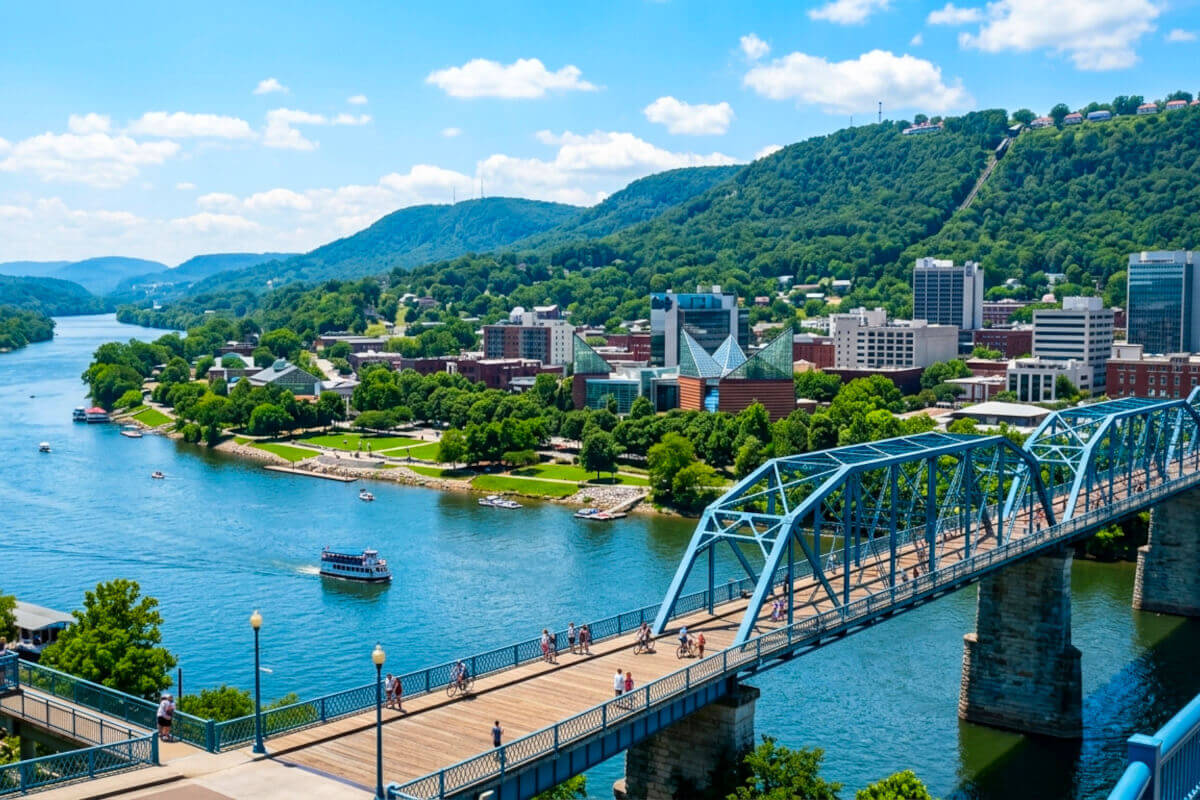
Where the Tennessee River carved a city — and the Civil War shaped a nation — at the foot of Lookout Mountain
Nestled where the Tennessee River bends through the ancient Appalachian foothills, Chattanooga is one of the American South’s most compelling river cities, a place where Cherokee heritage, Civil War drama, industrial grit, and a spectacular outdoor landscape converge at water’s edge. For the small ship cruise traveler, it is far more than a port of call. It is, quite literally, where the journey begins or ends.
On American Cruise Lines’ Tennessee Rivers Cruise, Chattanooga serves as the embarkation or debarkation point for a nine-day voyage along the storied waterways of the Tennessee Valley. Whether you step aboard here at the start of an adventure, or glide in from Nashville to close one, this city rewards every hour you give it.
“The Cherokee called this river ‘Tanasi’ — the word that would eventually give an entire state its name. In Chattanooga, you are never far from that deep continuity of water and human memory.”
Today Chattanooga has become a model of urban reinvention. Once named the most air-polluted city in America in the 1960s, it transformed itself into a destination celebrated for outdoor adventure, riverfront culture, and world-class attractions, all woven together by the river that made it possible in the first place.
A City Written by the River
To understand Chattanooga, you must first understand the Tennessee River. For more than 10,000 years, Indigenous peoples, above all the Cherokee, built their world along these banks. They called the river “Tanasi,” a name that would travel far beyond these waters. The fertile riverbanks offered food, transportation, and trade, and the calm bends hosted villages and ceremonial sites. Interpretive markers along today’s Riverwalk honor this heritage at nearly every turn.
1816
Cherokee Chief John Ross establishes a trading post on the river’s north bank, known as Ross’s Warehouse, the founding nucleus of what would become Chattanooga. The site, now Ross’s Landing Riverfront Park, was listed on the National Register of Historic Places in 1974.
1839
The city is officially incorporated as Chattanooga, a name derived from a Creek word meaning “rock coming to a point,” a reference to the iconic Lookout Mountain that watches over it.
Mid-1800s
The intersection of the Tennessee River and major rail lines transforms Chattanooga into an industrial and commercial powerhouse. Steamboats line the docks; warehouses crowd the shore. The city becomes a vital hub linking Southern cities from Mobile to Knoxville, fueling a coal and iron economy.
1863
The city becomes one of the Civil War’s most strategically contested prizes. The Battles of Chickamauga and Chattanooga, including the famous “Battle Above the Clouds” on Lookout Mountain, reshape the war’s trajectory. The Chickamauga and Chattanooga National Military Park, established in 1890, is the nation’s oldest and largest military park and preserves these hallowed grounds today.
1933
The Tennessee Valley Authority (TVA) is created by congressional charter to provide flood control, navigation, and electrical generation for the depression-stricken Tennessee Valley. The Chickamauga Dam, 5,800 feet long and 129 feet high, impounds Chickamauga Lake north of downtown, ending the city’s chronic flooding and powering its future.
1992 – Present
A sweeping riverfront revitalization reconnects city and river. The Tennessee Aquarium opens as an anchor, parks and walking trails multiply, and the 13-mile Riverwalk emerges. Chattanooga earns designation as America’s first National Park City, only the third in the world, cementing its identity as a place where nature, culture, and history share the same waterfront.
The Tennessee Rivers Cruise
Small ship cruising on the Tennessee River is a fundamentally different experience from mass-market ocean travel. Aboard American Cruise Lines’ modern riverboats, the 175-passenger American Symphony and the 185-passenger American Splendor, you are never separated from the landscape by distance or crowds. The river is always present: outside your stateroom window, from the open sun deck, from the intimate dining room where nightly cocktail hours draw guests together over regional cuisine and river sunsets.
Tennessee Rivers Cruise — At a Glance
A nine-day luxury river journey through the heart of the American South, sailing between Chattanooga and Nashville (or in reverse). The itinerary weaves natural scenery, Civil War history, Indigenous heritage, and the soulful rhythm of country music into a single, seamless voyage.
Ports of call include Chattanooga, TN · Decatur, AL · Florence, AL · Savannah, TN · Paducah, KY · Lake Barkley Scenic Cruise · Nashville, TN.
Chattanooga’s role in the itinerary is unique: it functions as both gateway and destination. Cruisers receive a complimentary one-night hotel stay in the city before embarking, or spend a final afternoon here after disembarking. Either way, the city rewards every extra hour.
What distinguishes the small ship experience here is the vantage point itself. As your vessel glides away from the city’s riverfront, Lookout Mountain rises on the horizon and the Appalachian ridges close in on either side, a view that no road, no trail, and no overlook can quite replicate. The river corridor through Chattanooga is a geological drama that small ships are perfectly sized to inhabit.
Chattanooga’s Essential Experiences
With a pre-cruise overnight stay included in your Tennessee Rivers Cruise package, you have time to explore. Here are the experiences that define Chattanooga for the adventure cruise traveler.
Lookout Mountain & Point Park
The site of the Civil War’s “Battle Above the Clouds,” Lookout Mountain towers over the city and the river below. Ride the Lookout Mountain Incline Railway — one of the world’s steepest passenger railways — to the summit, then walk to Point Park and the Battles for Chattanooga Museum, where panoramic views of Moccasin Bend and the Tennessee River unfold. Ruby Falls, a dramatic underground waterfall deep inside the mountain, is nearby.
Tennessee Aquarium
Sitting prominently on the river’s edge, the Tennessee Aquarium was a catalyst for Chattanooga’s entire riverfront revival. Its River Journey exhibit, once the largest freshwater aquarium in the world, showcases native species including river otters and rare “River Giants,” while the Ocean Journey wing added in 2005 features sharks, penguins, jellyfish, and a butterfly garden. An IMAX theater rounds out the experience.
Walnut Street Pedestrian Bridge
Completed in 1891, this is one of the world’s longest pedestrian bridges, a beautiful cast-iron span connecting downtown to the vibrant North Shore neighborhood and Coolidge Park, with its historic 130-year-old carousel. The bridge offers sweeping views of the Tennessee River and the city skyline, and is a beloved landmark of Chattanooga’s urban character. (Note: as of 2025 the bridge was closed for renovation; check current status before visiting.)
Ross’s Landing Riverfront Park
The founding site of Chattanooga, named for Cherokee Chief John Ross, is now a beautifully renovated public park with a river pier, marina, natural amphitheater, and a unique system of wading streams. The Passage — an artistic tribute to the area’s Indigenous tribes — runs along the Riverwalk here, adjacent to the Tennessee Aquarium. It is the perfect orientation point for any visitor arriving by river.
Hunter Museum of American Art
Perched on a 90-foot bluff directly above the Tennessee River, the Hunter Museum combines three architecturally distinct buildings spanning different eras of American history. Its collection spans Colonial times to the present across painting, sculpture, fashion, photography, and mixed media. The river views from the terrace alone are worth the visit.
Chattanooga Choo Choo & Railroad Museum
The iconic 1909 train terminal, immortalized by the Glenn Miller song, is now a hotel, entertainment complex, and living tribute to the railroad era that made this city. Stay overnight in converted Pullman train cars, dine in the gardens, or simply walk through the grand hall. The Tennessee Valley Railroad Museum, the largest operating historic railroad museum in the South, offers rides on restored vintage locomotives through the surrounding countryside.
Chickamauga & Chattanooga National Military Park
Established in 1890, this is the nation’s oldest and largest military park, preserving the battlefields where the 1863 campaign for Chattanooga was decided. Cannons, monuments, and preserved terrain bring the battles of Chickamauga Creek and Missionary Ridge to life. The Cravens House on Lookout Mountain, the oldest surviving structure on the mountain and a pivotal Civil War focal point,is part of the park.
Coolidge Park & The Riverwalk
The 13-mile Tennessee Riverwalk winds along the waterfront past public art, marinas, parks, and eateries. Coolidge Park, with its nostalgic carousel and lush green lawns, is a favorite gathering place. Kayakers, paddleboarders, and pontoon boats share the water near Ross’s Landing, an easy way to experience the same river your cruise ship will navigate.
Bluff View Arts District
This quiet, European-style neighborhood perches on stone cliffs above the Tennessee River, home to the River Gallery Sculpture Garden, artisan bakeries, pasta shops, and wine bars. It’s among the most atmospheric corners of Chattanooga, and an ideal setting for a pre-cruise dinner with river views.
Best Time to Cruise to Chattanooga
The Tennessee Rivers Cruise runs April through October, a season shaped by the Southern climate’s dramatic arc from blooming spring to golden autumn. Each season offers a distinct personality on the river.
Wildflowers on the ridges, dogwoods in bloom, mild temperatures ideal for walking. Lookout Mountain and the Riverwalk are at their most beautiful. April and May departures book early.
Hot and humid, but the river stays refreshing. Vibrant festivals, long evenings, and the best paddling conditions. Early morning excursions are recommended.
Arguably the most spectacular season. Appalachian foliage transforms the ridges into a tapestry of color viewed perfectly from the river deck. September and October are peak.
The season winds down with the last October sailings. Cooler air makes deck time brisk but invigorating; foliage may still linger on upper elevations.
For most small ship travelers, late September and early October represent the sweet spot: the summer crowds thin, temperatures become ideal for walking and exploring, and the Tennessee Valley’s hardwood forests begin their annual transformation, a spectacle best appreciated from the water, where the reflected colors double the drama.
Spring sailings in April and May are also exceptional, particularly for wildflower enthusiasts and those who want to experience Lookout Mountain’s rhododendron blooms. These departures tend to sell quickly.
Practical Matters
Getting to Chattanooga
Chattanooga Metropolitan Airport (CHA) offers direct connections from Atlanta, Charlotte, Chicago, and other major hubs. Alternatively, Chattanooga is an easy drive from Atlanta (2 hours), Nashville (2 hours), and Knoxville (1.5 hours) — making pre- or post-cruise road trips an attractive option. The ship docks at the downtown riverfront, within walking distance of most major attractions.
What’s Included on the Tennessee Rivers Cruise
American Cruise Lines’ all-inclusive fare covers cruise passage, all gourmet meals, breakfast room service, daily snacks, evening cocktail hours, onboard entertainment, an acclaimed enrichment lecture program, and Wi-Fi throughout the ship. The pre-cruise hotel night in Chattanooga is also included. Most shore excursions are an additional cost and can be arranged through the cruise line or independently.
Packing for River Cruising in the Tennessee Valley
Pack layers regardless of season, mornings on the river run cool even in summer. Comfortable walking shoes are essential for exploring Civil War parks and mountain trails. Binoculars are worthwhile on a river cruise: the birding along the Tennessee Valley is exceptional, particularly during spring and fall migration. Sun protection is important on the open deck.
Beyond Chattanooga: The Full Tennessee Rivers Itinerary
Your cruise continues beyond Chattanooga through some of the Tennessee Valley’s most compelling stops. In Decatur, Alabama, the historic Old State Bank and Wheeler National Wildlife Refuge await. Florence, Alabama holds the only Frank Lloyd Wright-designed home in the state. Savannah, Tennessee provides access to Shiloh National Military Park, one of the Civil War’s most evocative battlefields. Paducah, Kentucky, where the Ohio and Tennessee Rivers converge, is home to the National Quilt Museum, a UNESCO Creative City of Crafts. The voyage culminates, or originates, in Nashville, the living capital of American country music.
“Aboard a small ship, the Tennessee Valley reveals itself at the pace it deserves — not glimpsed from a highway or compressed into a day tour, but absorbed slowly, mile by mile, as the Appalachian ridges recede and the river opens into something wider and more mysterious.”
Booking the Tennessee Rivers Cruise
The Tennessee Rivers Cruise is operated by American Cruise Lines. Fares start at $4,295 per person and vary by cabin category and sailing date. Multiple cabin types are available, from standard waterviews to Grand Suites with private balconies. The cruise operates on both the American Symphony (175 passengers) and the American Splendor (185 passengers), both modern riverboats purpose-built for intimate river exploration.
To request a brochure or book, contact Sunstone Tours & Cruises at 1-888-815-5428.
Why Chattanooga Belongs on Your River Map
There are river cities that serve as logistics, and there are river cities that become the reason you took the trip. Chattanooga is firmly in the second category. It is a place built by the water, defined by conflict and reinvention, and now celebrated for the kind of authentic outdoor-meets-cultural experience that travelers increasingly seek and rarely find so fully realized in a single destination.
For the small ship adventurer, the resonance runs even deeper. Arriving or departing by riverboat is not just a transportation choice, it is the proper way to meet a city whose entire identity is inseparable from the Tennessee River. To glide past Ross’s Landing at dawn, with Lookout Mountain catching the first light above the Appalachian mist, is to understand Chattanooga the way it has always understood itself: as a city of water, of passage, and of stories still being told.