
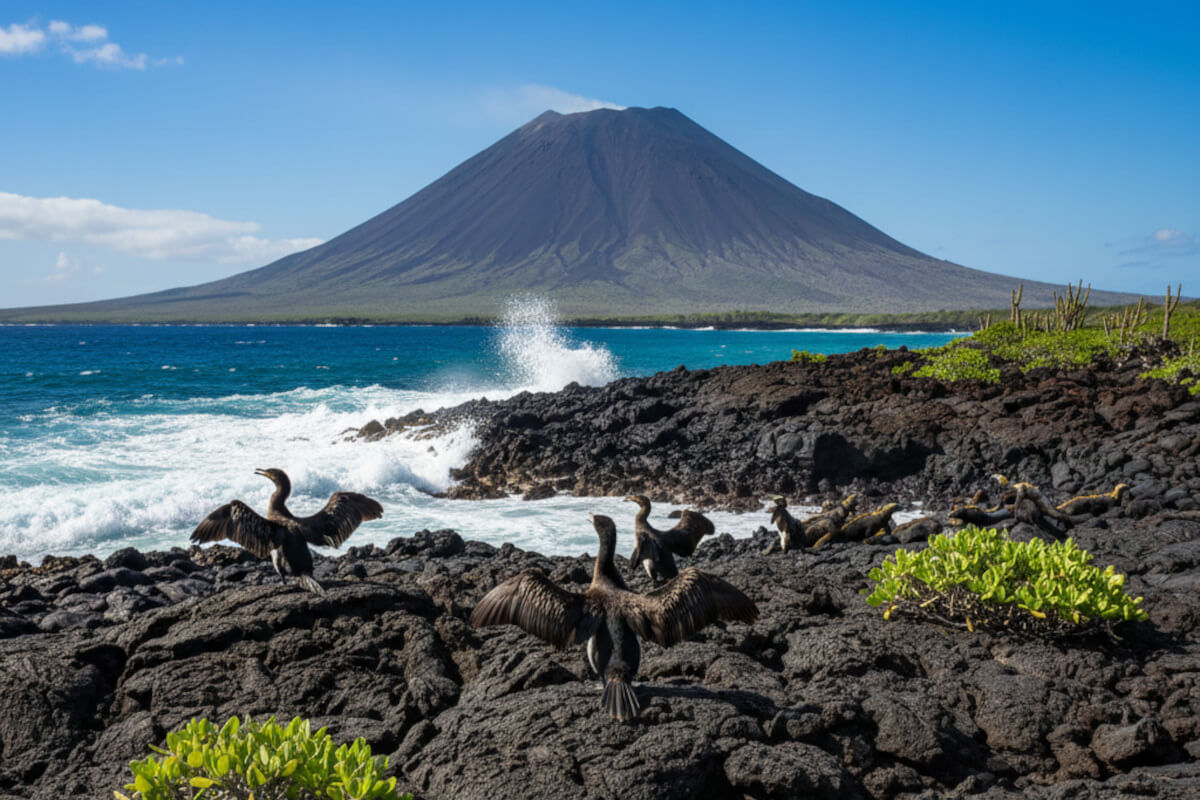
The Galápagos’ Wildest, Most Rewarding Frontier
There’s a moment on every great Galápagos voyage when the archipelago stops feeling like a checklist of famous wildlife photos and starts feeling like the edge of the world. For most travelers, that moment happens at Genovesa.
Tucked into the far northeast of the archipelago and bisected by the equator, Genovesa is the Galápagos at its most remote and least visited, a horseshoe-shaped volcanic caldera rising from the sea, its flooded crater forming a natural amphitheater for one of the densest concentrations of seabirds on Earth. Getting there takes commitment: a full night or more of sailing beyond the range of day-trip boats and standard-issue itineraries. That distance is precisely what makes it extraordinary. Few travelers make it this far north, and the payoff is an island that feels genuinely undiscovered.
This is a guide for the affluent, experience-driven traveler weighing an expedition cruise that includes Genovesa, what it takes to get there, what awaits once you do, who this kind of trip suits, how to prepare, and which current itineraries actually call at the island.
Getting There
Genovesa isn’t accessible on its own. You reach it as part of a multi-day small-ship expedition cruise through the Galápagos, typically beginning and ending in Guayaquil or Quito, Ecuador, with a short flight to the islands, usually into Baltra, to embark your ship.
From there, Genovesa is a northern outlier relative to the more commonly visited central and southern islands (Santa Cruz, Santiago, Española, Isabela). Reaching it generally requires an overnight sailing across the equator, which is why it appears only on longer, more comprehensive itineraries, typically 10 days or more, rather than shorter escape-style cruises that concentrate on the archipelago’s central islands. Because access depends entirely on itinerary design and Galápagos National Park regulations governing visitor sites, the single most important decision an affluent traveler makes isn’t the ship, it’s choosing a cruise whose route is actually built to include Genovesa.
What You’ll See and Experience
Genovesa is often nicknamed “Bird Island,” and the name undersells it. The flooded caldera at its heart, Darwin Bay, creates sheltered turquoise water ringed by cliffs and beaches where an estimated one million or more seabirds nest, feed, and raise their young largely undisturbed by predators or people.
On land
Expect two signature landing sites:
- Darwin Bay Beach, a coral-sand beach inside the caldera where short trails wind through mangroves and past nesting colonies of red-footed and Nazca boobies, magnificent and great frigatebirds mid-courtship display, and swallow-tailed gulls, the world’s only nocturnal gull.
- Prince Philip’s Steps (El Barranco), a steep staircase cut into the cliff face leading to a plateau thick with seabird activity, short-eared owls that hunt storm petrels in daylight, and sweeping views over the caldera.
In and on the water
Genovesa consistently delivers some of the richest snorkeling and kayaking in the archipelago: Galápagos fur seals and sea lions hauled out along the cliffs, hammerhead sharks patrolling deeper water, sea turtles, manta rays, and playful young sea lions that often approach snorkelers out of curiosity rather than caution. Kayaking or paddleboarding along the base of the caldera’s cliffs, with thousands of birds wheeling overhead, is the kind of moment that tends to anchor people’s memory of the entire trip.
Naturalist guides, often with advanced degrees in ecology, ornithology, or marine biology, accompany every landing and excursion, which is part of what separates a genuine expedition cruise from a standard sightseeing tour: the context and expertise turn a walk on a beach into a real understanding of how this ecosystem works and why it’s so fragile.
Who These Cruises Are For
Genovesa-inclusive itineraries suit a particular kind of traveler more than a particular budget bracket, though they do tend to run at the premium end of Galápagos cruising:
- Repeat or serious wildlife travelers who’ve done, or want to skip past, the archipelago’s greatest hits and are drawn to its least-trafficked corners.
- Active, physically capable travelers. Wet and dry landings, uneven volcanic terrain, steep steps, and regular snorkeling or kayaking are standard. This isn’t a cruise for guests who want to stay aboard.
- Birders and photographers, for whom Genovesa’s seabird colonies are a bucket-list destination in their own right.
- Families with older children and teens, particularly on itineraries with dedicated youth naturalist programming, the extended, island-rich routes that reach Genovesa often coincide with school-holiday sailings.
- Travelers who value time over price. Because Genovesa requires additional sailing days, itineraries that include it run longer (typically 10 to 12 days rather than 7 or 8) and cost more accordingly. This is a traveler who’s decided depth of experience matters more than trip length or headline price.
It’s a poorer fit for first-timers with limited mobility, travelers on a tight schedule who want the shortest possible Galápagos sampler, or anyone prone to seasickness who’d rather avoid an overnight equatorial crossing.
How to Prepare
- Book early, and book the itinerary, not just the ship. Genovesa departures are limited by park regulations on visitor numbers per site, and the longer itineraries that include it sell out well in advance, especially around December holiday sailings.
- Pack for sun, sea, and scrambling. Reef-safe sunscreen, a wide-brimmed hat, quick-dry layers, sturdy water shoes or sandals for wet landings, and a light rain jacket cover most conditions. Water and land temperatures near the equator stay warm year-round, but the cliffs and lava terrain demand real footwear, not flip-flops.
- Bring a proper camera and a dry bag. Genovesa is arguably the best wildlife photography island in the archipelago; a zoom lens for birds in flight and a waterproof case or housing for snorkeling shots will get real use.
- Prepare physically. Expect to snorkel most days, hike over uneven volcanic rock, and climb steep steps at Prince Philip’s Steps. A reasonable baseline of fitness makes the difference between enjoying these excursions and sitting them out.
- Get travel and medical evacuation insurance. Given the remoteness of the northern islands, a solid travel protection plan is worth the modest cost.
- Consider bookending the cruise. Many Genovesa itineraries pair naturally with time in Quito, Guayaquil, or even Peru’s Sacred Valley and Machu Picchu — worth building into the trip rather than treating the cruise as a standalone.
Itineraries That Visit Genovesa
Not every Galápagos cruise reaches Genovesa, it’s worth confirming explicitly before booking. Two current expedition itineraries are built to include it:
- Exploring Galápagos (10 days) Aboard the 96-guest National Geographic Endeavour II or the 48-guest National Geographic Gemini, roundtrip from Quito or Guayaquil. This comprehensive route through the central, western, and northern islands includes a crossing to Genovesa’s flooded caldera, with landings at Darwin Bay and Prince Philip’s Steps alongside stops at Isabela, Fernandina, Española, Santiago, Santa Cruz, and San Cristóbal. It’s the more accessible of the two Genovesa-inclusive options, both in price and in typical year-round availability.
- Ultimate Galápagos Holiday Voyage (10–12 days) Aboard the 48-guest National Geographic Islander II, roundtrip from Guayaquil, timed around the December holidays. This extended route sails from Santa Cruz south to Floreana, east to Española and San Cristóbal, then north across the equator to Genovesa, the deepest, most complete Galápagos itinerary currently offered, with daily options to hike, snorkel, kayak, and paddleboard. It also runs a National Geographic family program for traveling with kids and teens.
Both are operated by Lindblad Expeditions, whose naturalist-led approach and 50-plus years in the islands are built around exactly this kind of in-depth, conservation-minded exploration.
Ready to explore Genovesa and the Galápagos? Contact Sunstone Tours & Cruises toll-free at 1-888-815-5428. A specialist can help confirm current departure dates, cabin availability, and whether a particular sailing’s exact route includes Genovesa — itineraries are subject to change based on Galápagos National Park regulations.