
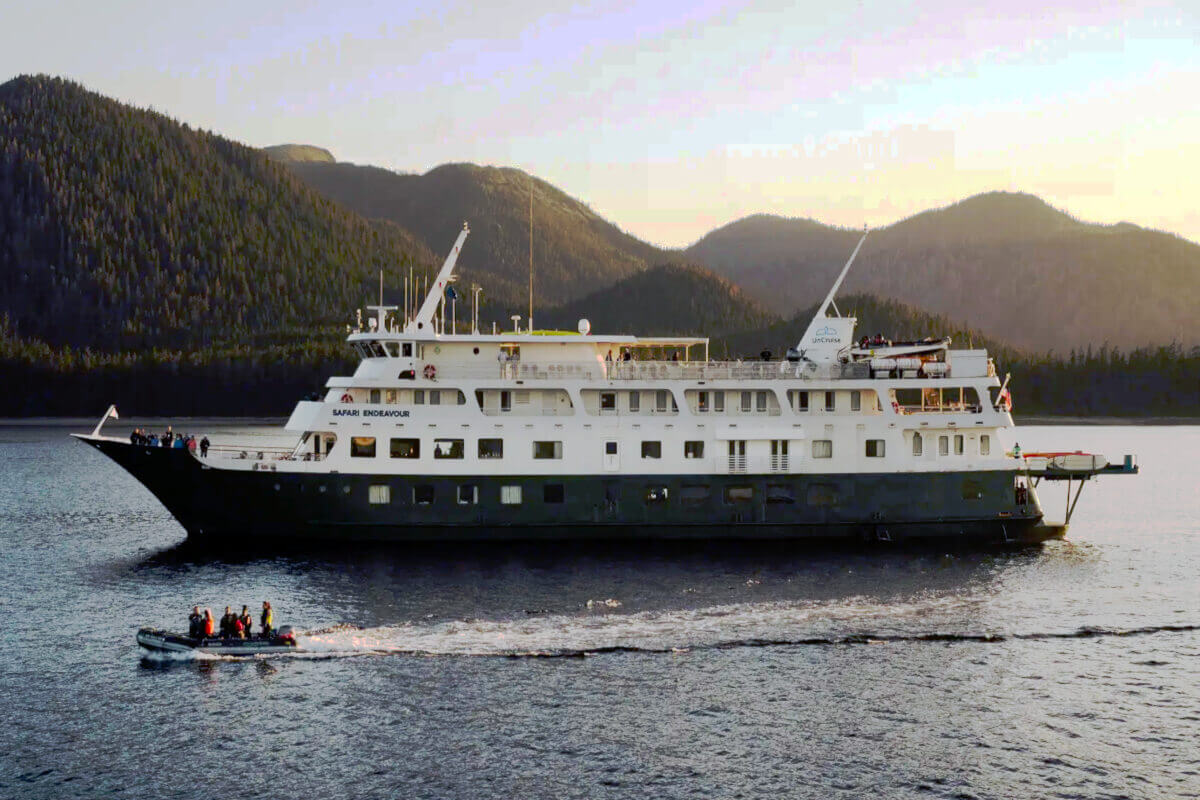
Many Alaska cruise travelers sail past Icy Strait without knowing what they’ve missed. On an expedition-style small ship, it can be the most memorable day of the voyage.
Icy Strait is the gateway where the open Pacific flows into northern Southeast Alaska. The surrounding land and water are remote, nutrient-rich and full of life. For affluent travelers who want more than a view from a crowded deck, this is Alaska at its most immersive.
What Is Icy Strait?
Icy Strait is a wild stretch of water at the northern edge of the Inside Passage. It sits beside the rugged northern coast of Chichagof Island and close to Glacier Bay National Park.
Cold, plankton-rich currents move through the strait. They draw whales, sea lions, porpoises and seabirds, and they feed the bears that patrol the nearby shorelines.
On small-ship itineraries, Icy Strait gets a full day of exploration rather than a passing glance. The itinerary describes it as an interface between land and sea that is “remote and wild” and set aside for whales and marine mammals.
Why Visit Icy Strait by Small Ship?
Large ships keep to established routes and ports. An 84-guest expedition vessel like UnCruise Adventure’s Safari Endeavour can anchor in quiet coves and put you on the water in kayaks, paddleboards and skiffs within minutes.
For discerning travelers, the small-ship advantage comes down to a few things:
- Flexibility. Expedition leaders scout each morning and shape the day around wildlife and weather.
- Access. Small vessels reach secluded coves and shorelines that larger ships can’t.
- Personal expertise. Naturalist guides bring the area’s ecology, geology and history to life.
- Inclusive comfort. Fares include all meals aboard, premium wine, beer and spirits, non-alcoholic beverages, and all activities and equipment, along with park entry fees.
What to See and Do in Icy Strait
Whale watching and marine wildlife
Icy Strait is a whale-watching destination. Expect humpback whales, orcas, porpoises and dolphins, and keep an eye out for the spouts and fin slaps that give them away. Steller sea lions often follow kayakers and skiffs through the water. Dolphins and porpoises may ride the bow wave as your ship moves from cove to cove.
Bubble-net feeding, in which humpbacks cooperate to trap fish, is a highlight on the Northern Passages itineraries.
Kayaking and paddleboarding
Paddling is one of the best ways to experience Icy Strait. Glide along kelp-threaded channels in clear blue water that looks surprisingly tropical. You can join an all-day paddle, try a “yak-and-walk” combination, or take an open paddle at your own pace.
Old-growth rainforest hiking
Just inside the forest edge stand trees older than the United States. Guided shore walks and bushwhack hikes reveal the Tongass National Forest, which one itinerary compares to the “Amazon” of North America. Active travelers can choose more challenging routes, while others can opt for gentle meadow or shoreline walks.
Skiff exploration and intertidal discovery
Skiff rides reach stretches of coastline that are otherwise unreachable. Along the shore, tide pools act as natural touch tanks, with sea stars, urchins and edible kelp.
Coastal brown bears on Chichagof Island
Chichagof Island is known for some of the best bear viewing in Southeast Alaska. Your captain and expedition leader use local knowledge to find coastal brown bears foraging along salmon streams. You watch from the water or from the shoreline, at a safe distance.
Glacier Bay National Park
Icy Strait pairs naturally with Glacier Bay National Park, a UNESCO World Heritage Site and Biosphere Reserve. Tidewater glaciers such as Margerie and Johns Hopkins rise from the water. You may spot puffins, sea lions, harbor seals and mountain goats. Kayaking, hiking and skiff touring bring you closer to the ice than a ship’s rail can.
Cruise Itineraries That Visit Icy Strait
Two Sunstone Tours & Cruises itineraries from UnCruise Adventures include a dedicated Icy Strait day. Both sail aboard the 84-guest Safari Endeavour, and both run 8 days between Juneau and Sitka, in either direction.
Northern Passages with Glacier Bay & Sitka (April to September; from $6,300 per person)
- Day 3 is Glacier Bay National Park, followed by Icy Strait on Day 4.
- Chichagof Island, Peril Strait, Baranof Island, and the Krestof and Nakwasina Sounds fill the rest of the week.
- It ends in historic Sitka, where you can visit the Alaska Raptor Center or Sitka National Historical Park.
Adult Escape: Northern Passages with Glacier Bay & Sitka (May and July to September; from $6,300 per person)
- This is an adults-only sailing, described as a peaceful “adult summer camp.”
- Icy Strait is Day 4, with a focus on whales, sea lions, porpoises and old-growth forest.
- Glacier Bay follows on Day 6, with a Captain’s Choice day in the Tongass National Forest before Juneau.
Rates, dates and availability change. 2027 early-booking savings of $500 per person on April, May and September departures and $350 per person on June through August departures, for bookings made by December 31, 2026. Confirm current pricing before booking.
Best Time to Visit Icy Strait, Alaska
The cruise season runs from April through September. The best month depends on what you most want to see, based on Sunstone’s Alaska seasonality chart.
| Month | Avg. Temp (°F) | Highlights |
|---|---|---|
| April | 48° / 33° | Best for gray whales and bird migrations; best for Northern Lights |
| May | 60° / 39° | Best for gray whales, bears and bird migrations; driest of the season |
| June | 65° / 44° | Best for humpbacks, bears and spawning salmon |
| July | 68° / 49° | Best for humpbacks, bears and spawning salmon; warmest month |
| August | 65° / 46° | Best for humpbacks, bears, salmon and bird migrations |
| September | 59° / 42° | Best for gray whales and Northern Lights; wettest month |
Best overall for whales and bears: June through August is the peak window. Humpback whales, bears and spawning salmon all rate “best” in these months.
Best for a quieter, shoulder-season trip: May offers bears, gray whales and bird migrations with lighter rainfall. September offers gray whales and some of the best Northern Lights chances, though it is the rainiest month.
Best for Northern Lights: April and September. This is a chance, not a guarantee, and clear skies are required.
Packing tip: Pack layers and waterproof gear whatever the month. Southeast Alaska is a temperate rainforest, and conditions change quickly on the water.
Plan Your Icy Strait Adventure
Icy Strait rewards travelers who want to be active participants in the landscape, not spectators. A small-ship itinerary combines expert guides, inclusive luxury and access to wild places in a single week.
Reserve your Northern Passages itinerary by contact Sunstone Tours & Cruises toll-free at 1-888-815-5428.