
America’s Oldest Seaport — Where History, Art & the Atlantic Converge
Some ports simply receive ships. Gloucester, Massachusetts, has been receiving them for four centuries, and the sea has shaped every stone, every canvas, and every soul here. Thirty miles northeast of Boston on the rugged peninsula of Cape Ann, this storied city holds the singular distinction of being America’s first seaport, founded in 1623 when men from Dorchester, England, arrived to establish a fishing and trade plantation. What they built endures today: a working harbor still thick with the smell of salt and diesel, galleries overflowing with art that the Atlantic itself seems to have commissioned, and a coastline that rewards the traveler who arrives, as the most discerning always have, by water.
For the affluent small-ship cruiser, Gloucester offers something no five-star resort can replicate: the authentic pulse of a port city that has never stopped working. A call here is not a theme-park recreation of maritime life, it is maritime life, raw and vivid, offered alongside world-class museums, a legendary art colony, extraordinary seafood, and the kind of whale-watching that ranks among the finest on the Eastern Seaboard.
Sunstone Tours & Cruises features Gloucester as a marquee port of call on the 11-day New England Explorer Cruise with American Cruise Lines, sailing roundtrip from Boston aboard the 130-guest American Pioneer or American Maverick. The intimate scale of these vessels, purpose-built for coastwise New England cruising, means passengers arrive directly at the heart of the harbor, steps from the Fishermen’s Memorial and the working docks that have defined this city’s identity for four hundred years.
A History Written in Salt Water
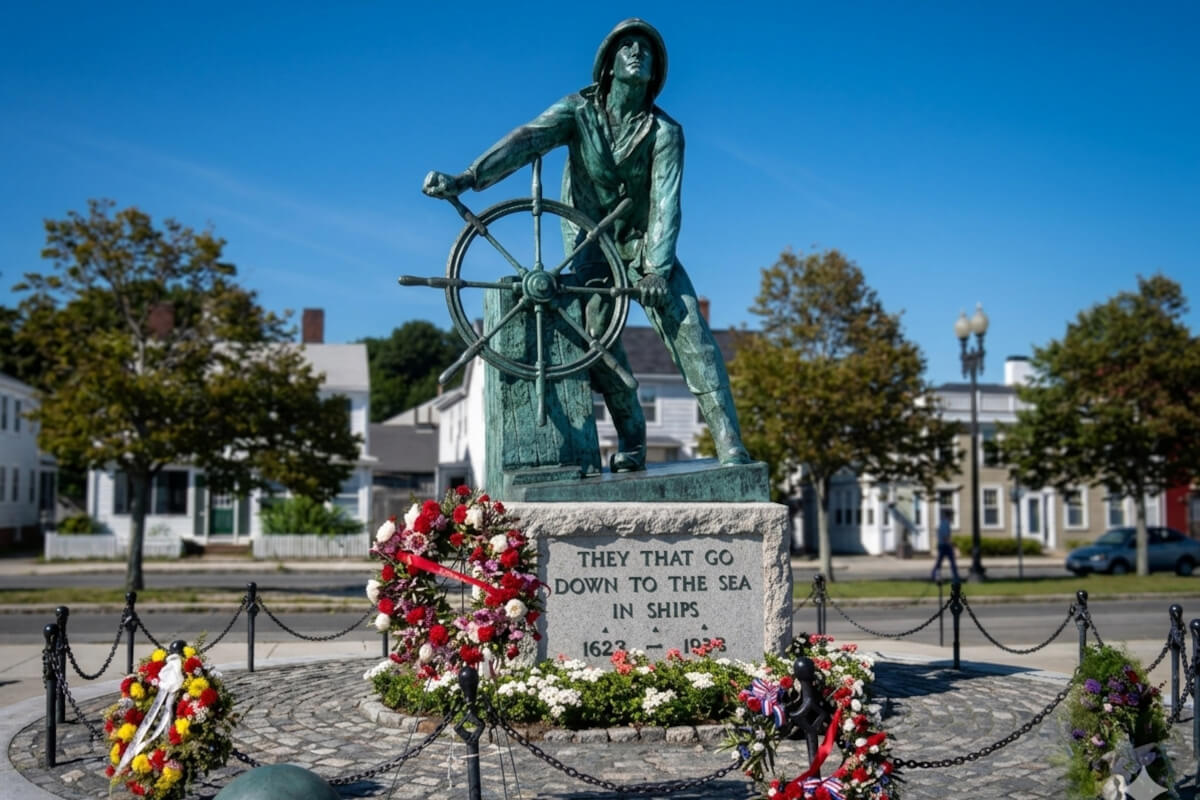
Gloucester’s story is inseparable from the Grand Banks. By the 17th century, fishing schooners were departing these docks on weeks-long voyages to the cold, teeming waters off Newfoundland and Nova Scotia, returning, if fortune held, with cod and halibut enough to feed the Atlantic world. At its peak, the Gloucester fishing fleet numbered in the hundreds of vessels, and the city’s fish-processing industry earned it global renown. The toll was tremendous: more than ten thousand Gloucester fishermen have perished at sea since the port was founded in 1623, a sacrifice memorialized in the city’s iconic Fishermen’s Memorial, the “Man at the Wheel”, erected in 1925 on the city’s tercentenary.
The schooner era gave way to steam, and steam to modern trawlers, yet Gloucester never entirely left its past behind. The Adventure, the last American dory fishing schooner in the Atlantic, has been lovingly restored and still sails from this harbor. The Gloucester Maritime Heritage Center, housed in a 19th-century mill building and former ice house, maintains the oldest continuously operating marine railway in the country, the Harriet Webster Pier, a living monument to the shipbuilding and repair trades that sustained the fleet.
Beyond fishing, Gloucester’s harbor attracted artists almost as soon as it attracted fishermen. By the mid-19th century, the particular quality of the Cape Ann light, luminous, ever-shifting, softened by the Atlantic, was drawing painters of the first rank. Winslow Homer lived and worked here in 1880, painting seascapes and the everyday life of the harbor with the Lighthouse Keeper at Eastern Point. The colony that grew on Rocky Neck, a small peninsula jutting into the working harbor, became the oldest continuously operating art colony in the United States, drawing not only Homer but Edward Hopper, Childe Hassam, Frank Duveneck, and later such modernists as Mark Rothko, Milton Avery, and Stuart Davis.
When to Go: Seasons with the New England Explorer
The New England Explorer operates between May and September, and Gloucester rewards visitors in each of those months, though each offers a distinctly different experience.
Late Spring (May – early June)
The harbor emerges from winter with a freshness that early-season travelers find irresistible. Whale-watching season opens in earnest, humpbacks, fin whales, and minke whales are actively feeding on Stellwagen Bank National Marine Sanctuary, Gloucester’s closest major feeding ground and one of the richest cetacean habitats on the East Coast. Crowds have not yet arrived, galleries and restaurants are hungry for visitors, and the light is crisp and brilliant. Sailings from late May through early June offer fares at the lower end of the season range, making this an excellent value proposition for the discerning traveler who prizes quiet harbors over high-season bustle.
Summer (July – August)
Peak season brings Gloucester to full, exhilarating life. Rocky Neck’s galleries are open and vibrant; the Annual Gloucester Schooner Festival and Maritime Heritage Day takes place over Labor Day weekend and is a spectacle of extraordinary beauty, tall ships, schooner races, and the full pageantry of a port city celebrating its own identity. Good Harbor Beach and Wingaersheek Beach are at their warmest, and every restaurant along the waterfront is operating at full form. This is the Gloucester of postcards and memory: riotous, sun-drenched, and alive with the particular joy that only a seaside summer can produce.
Early Fall (September)
September is arguably the most sophisticated time to visit. The summer crowds thin, the light softens toward gold, and the harbor takes on an atmospheric quality that explains precisely why painters have been arriving here since the 1840s. Whale-watching remains excellent through early November; dining reservations are easier to secure; and the first brushstrokes of fall foliage begin to appear in the inland reaches of Cape Ann.
Late September sailings on the New England Explorer offer the highest per-person rates of the season, a reflection of the premium that experienced travelers place on autumn in New England.
Highlights: What to See & Do in Gloucester
Set Sail on a Traditional Schooner
The New England Explorer itinerary includes a sailing excursion aboard a traditional schooner from Gloucester, an experience that connects the traveler directly to the city’s four centuries of seafaring identity. To stand at the rail of a working wooden schooner as it clears the harbor mouth and meets the open Atlantic is to understand, viscerally and immediately, what this port has meant to American history. The Schooner Thomas E. Lannon and the historic Schooner Ardelle, maintained by Maritime Gloucester, are among the vessels available for such passages.
Cape Ann Museum
For the culturally engaged traveler, the Cape Ann Museum (27 Pleasant Street) is essential. Its collections encompass the full arc of the region’s artistic and maritime heritage: seascapes and harbor views by Fitz Henry Lane, Winslow Homer, Cecilia Beaux, and John Sloan; rich documentation of the Cape Ann art colony and its influence on American Impressionism; and extensive holdings related to the fishing industry, granite quarrying, and the domestic life of coastal New England. Admission is $15 for adults. The museum recently expanded with Cape Ann Museum Green, an outdoor campus at 13 Poplar Street featuring three historic structures.
Hammond Castle Museum
One of the most singular private residences in New England, Hammond Castle was built by the eccentric inventor John Hays Hammond Jr. as both a home and a laboratory. Perched atop the bluffs of Cape Ann overlooking the Atlantic, the medieval-inspired structure houses Hammond’s private collection of artifacts spanning ancient Rome through the Renaissance, armor, tapestries, sculpture, and antique furnishings assembled with the obsessive connoisseurship of a man who held more than 800 patents and counted among his friends the leading minds of the early 20th century. Guided and self-guided tours run from April through December.
Rocky Neck Art Colony
Rocky Neck, a small peninsula within Gloucester’s working harbor, separated from the East Main Street neighborhood by the intimate bowl of Smith’s Cove, is the oldest continuously operating art colony in the United States. Its legacy is extraordinary: Homer, Hopper, Hassam, Rothko, Avery, and Gottlieb all worked here, drawn by what resident artists describe as a unique quality of light and the unmediated proximity of the working waterfront. Today, dozens of working artists, painters, potters, textile designers, jewelers, photographers, display their work in Rocky Neck galleries each summer. The Rocky Neck Art Colony’s home in a Carpenter Gothic meetinghouse built in 1877 stages an active calendar of exhibitions, talks, workshops, and concerts.
Maritime Gloucester & the Harriet Webster Pier
Situated on the historic harbor at 23 Harbor Loop, Maritime Gloucester occupies an industrial property that preserves the oldest operating marine railway in the United States, the Harriet Webster Pier, a working relic of the age when scores of schooners required constant maintenance and repair. The Gorton’s Schooner Gallery, the Maritime Science Education Center, and a seasonal Sea-Pocket Aquarium make this a destination for travelers of all ages. The facility’s outdoor working waterfront, where fishing and pleasure vessels still undergo restoration, offers an unscripted and entirely authentic encounter with the port’s living heritage.
Whale Watching at Stellwagen Bank
Gloucester’s position at the northern edge of Massachusetts Bay places it closer to Stellwagen Bank National Marine Sanctuary than any other major port in New England, a geographic fact that translates into some of the finest whale-watching on the Eastern Seaboard. Humpback, fin, minke, and sei whales feed actively on the bank from April through November; sei turtles, dolphins, and harbor seals are frequent companions on the passage out. Cape Ann Whale Watch operates aboard Hurricane II, the largest and fastest whale-watch vessel north of Boston, accompanied by expert naturalists. Seven Seas Whale Watch and Capt. Bill & Sons offer additional departures for travelers wishing to compare experiences.
The Gloucester HarborWalk & Fishermen’s Memorials
The free, self-guided Gloucester HarborWalk guides visitors through the port’s layered history via 42 granite story posts set into the waterfront promenade, each one linked to audio content accessible by mobile phone. The walk passes the iconic Fishermen’s Memorial (“The Man at the Wheel”), the deeply moving Gloucester Fishermen’s Wives Memorial erected by the Gloucester Fishermen’s Wives Association to honor the women who sustained the community through absence and loss, and the working docks where lobster boats and draggers still unload their catch. This is a walk of genuine historical weight, offered freely and without mediation to anyone willing to follow the harbor’s edge.
Eastern Point Lighthouse
Built in 1832 at the entrance to Gloucester Harbor, the Eastern Point Lighthouse is one of the most photographed navigational aids in New England. The Dog Bar Breakwater, a granite jetty extending from the lighthouse grounds, offers a memorable walk over open water with panoramic views of the harbor, the open Atlantic, and on clear days the Boston skyline. Winslow Homer lived here in 1880, lodging with Lighthouse Keeper Charles Friend, and produced some of his finest harbor paintings from this vantage. The Gothic Revival keeper’s dwelling is a National Historic Landmark.
Good Harbor Beach
For travelers who wish simply to sit before the Atlantic and appreciate what has drawn artists to this coast for nearly two centuries, Good Harbor Beach is the finest beach on Massachusetts’s North Shore, a long, gently curving crescent of white sand backed by low dunes, with the granite mass of Salt Island visible just offshore. At low tide the flats extend far enough to walk to the island. The quality of afternoon light here, particularly in late summer and early fall, explains more about the Cape Ann artistic tradition than any museum exhibit could.
Dining: Seafood at Its Source
Gloucester’s proximity to the fishing grounds, and the presence of working vessels unloading catch at the docks behind the restaurants that will serve it the same evening, means that seafood here occupies a category of freshness beyond what most coastal destinations can honestly claim. The city has created a self-guided Seafood Trail connecting restaurants, markets, and maritime attractions that together tell the story of the Atlantic harvest.
Recommended dining for the discerning traveler:
- 1606 Restaurant and Oyster Bar: Award-winning waterfront dining; voted Best Waterview and Best Alfresco Dining by North Shore Magazine. Modern American cuisine with an emphasis on local seafood and an exceptional raw bar.
- 51 Rocky Neck: Located within the art colony on the inner harbor. Celebrated for its exceptional water views, fresh catch preparations, and the Lobster Shepherd’s Pie, a dish that captures the richness of the local harvest in a single, deeply satisfying form.
- The Dining Rooms at The Castle (141 Essex Ave): Elevated fine dining experience in a setting befitting the city’s most architecturally distinguished address.
- Seaport Grille (6 Rowe Square): Waterfront dining on the inner harbor with a comprehensive seafood menu and direct views of the working port.
- The Salted Cod Arthouse (53 Rocky Neck Ave): A spirited combination of gallery and restaurant at the heart of the Rocky Neck Art Colony, committed to serving fresh local ingredients alongside rotating exhibitions of Cape Ann art.
Arriving by Small Ship: The New England Explorer Cruise
Gloucester appears on Day 7 of the New England Explorer itinerary, arriving after calls at Portland, Rockland, Bar Harbor, Boothbay Harbor, and Bath, a progression through the maritime heritage of northern New England that gives Gloucester its proper context as the southernmost, oldest, and in many ways most complete expression of the region’s seagoing identity.
The ships assigned to this itinerary, the 130-guest American Pioneer and American Maverick, are purpose-designed for coastal New England cruising, with traditional bow profiles, full stabilization, and private veranda staterooms that place the harbor views where they belong: at the center of the experience. All gourmet meals, cocktail hours, an acclaimed enrichment program, and Wi-Fi are included in the fare. Most shore excursions are additional, though the schooner sailing from Gloucester is a signature activity of the voyage.
Fares for the 11-day New England Explorer begin at $10,170 per person (double occupancy, Premium Balcony) for spring departures and rise to $11,895 for fall sailings, a pricing structure that reflects both the seasonal demand and the exceptional quality of the autumn New England experience. Grand Suite accommodations are available at approximately $16,440–$18,300 per person on selected departures. Sunstone Tours & Cruises can be reached at 1-888-815-5428 for availability and booking.
Practical Notes for the Discerning Traveler
Getting Your Bearings
Gloucester is located on Cape Ann, approximately 30 miles northeast of Boston, and is easily accessible by commuter rail from North Station on the MBTA Rockport Line for those wishing to arrive early or extend a stay. The city occupies more than 60 miles of coastline, and its principal attractions, the harbor, Rocky Neck, Eastern Point, Good Harbor Beach, are best navigated by taxi, rideshare, or private car arranged through the ship’s concierge. The Gloucester HarborWalk, accessible on foot from the dock, is the ideal first orientation to the city.
Where to Stay (for Extended Visits)
Travelers who wish to extend their time in Gloucester before or after their cruise will find a handful of options that merit consideration: the Beauport Hotel Gloucester, a full-service oceanfront property featuring a rooftop pool and coastal dining, is the city’s most prominent luxury hotel; the Ocean House Hotel at Bass Rocks offers a smaller, more intimate experience with direct Atlantic views; and the Inn at Good Harbor Beach places guests steps from the finest sand in the region.
A Note on the City’s Character
Gloucester has resisted, with some success, the gentrification that has sanitized other New England ports. It remains a working city, proud, occasionally rough-edged, and profoundly authentic. The lobster boats that pass your veranda each morning are not props; the fishermen who haul gear on the dock behind the restaurants are not performers. This authenticity is Gloucester’s greatest gift to the traveler who has seen too many curated destinations. Come without the expectation of seamless luxury, come instead with appetite, curiosity, and enough knowledge of American history to understand what you are standing in the middle of when you walk these docks.